Reading Lichen on the Branch: Native Woody Cuts for Floral Installation
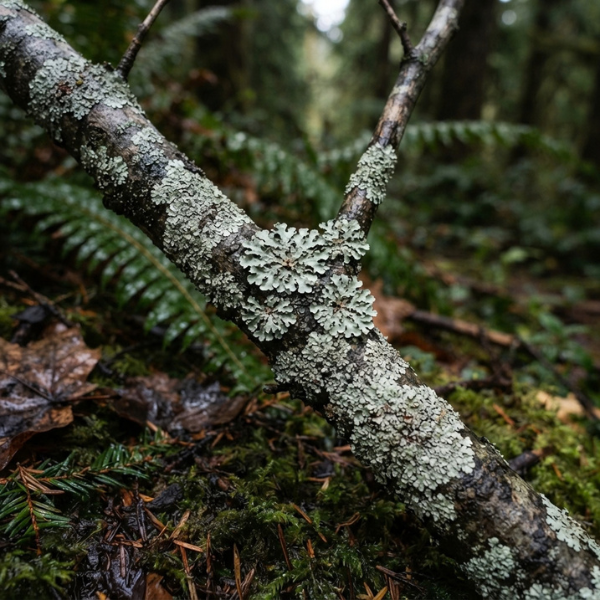
In early October, rain returns to the woodland, and the lichen on vine maple answers it quickly. On Acer circinatum this week, crustose lichen dominates: pale crusts that shift a stem’s tonal weight without touching its line. Foliose lobes appear here and there among them. Learning to tell the forms apart is one of the most useful ways to read native woody cuts for floral installation.
Lichen is not moss, and it is not a plant. It is a partnership between a fungus and an alga or cyanobacterium. It lives on bark without feeding on the tree. Lichenologists sort it by growth form: crustose, foliose, and fruticose. Those three words are also a designer’s vocabulary. Each one describes how lichen sits on a stem, and so how that stem behaves in a composition.
Three Growth Forms on Native Woody Cuts for Floral Installation
Crustose: lichen as surface
Crustose lichen grows as a crust fused to the bark. It cannot be lifted away without taking bark with it. On a branch, it reads as tone rather than texture: pale gray, chalky white, sometimes flecked with small dark fruiting bodies. It shifts a stem’s visual temperature without adding volume. A crustose-mottled branch keeps a clean silhouette. That makes it the quietest of the three, and often the most useful in sparse work. It is also what the woodland is carrying most heavily right now.
Foliose: lichen as layer
Foliose lichen grows in flat, leaf-like lobes, attached to the bark along its underside. Its upper and lower surfaces differ in color, so the lobe edges catch light. On the storm-fallen red alder (Alnus rubra) branches we are reading this week, foliose lichen appears in scattered rosettes, far fewer than the crusts around them. It adds a second layer to the stem. It reads as a soft, ruffled ground that sits close to the line without breaking it. Dry, the lobes curl and gray. Damp, they flatten and green.
Fruticose: lichen as gesture
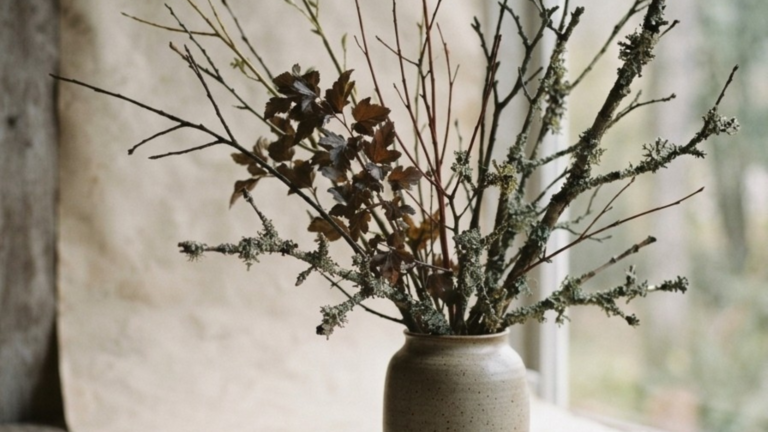
Fruticose lichen grows outward from a single point of attachment. It can be shrubby, strap-like, or hanging. It is the only form with true three-dimensional presence, and it moves. On the branches we are reading this week, it is the rarest of the three. Oakmoss lichen (Evernia prunastri) is the fruticose lichen most designers already know. Its forked straps are pale green above and whitish beneath, giving a branch a soft, two-toned fringe. We wrote about gathering oakmoss after the first storms last month. On a woody cut, fruticose lichen adds gesture. It softens the silhouette and carries movement along the line of the stem.
How PNW Woodland Materials Change After Rain
Lichen has no bloom and no leaf-out. Its season is moisture. Through a dry Pacific Northwest summer, most lichen sits dormant: brittle, pale, and compact. When autumn rain returns, it rehydrates and resumes growth. Its color deepens, and its lobes and straps relax. The window for reading lichen at its most expressive runs from the first autumn storms into early spring, while the woodland stays wet. That is also when wind brings lichen-bearing branches down.
Reading Lichen in a Composition
Read a lichen-bearing branch the way you would read its bare line. Three questions do most of the work.
Which growth form leads? Crustose stems hold the silhouette in sparse work. Foliose stems ground a composition at the base, where their layered surface reads up close. Fruticose stems soften edges and suit installation work viewed from a distance.
Does the lichen follow the line or interrupt it? Crustose follows the line almost exactly. Foliose rosettes can interrupt it at a node or a fork. Fruticose interrupts it by design, and that interruption is the gesture. Decide which you want before the stem enters the vessel.
Will it be read wet or dry? A branch that reads green and supple on the woodland floor will read grayer in a dry room. Plan the palette around the dry tone, not the wet one. Dry lichen is also brittle, so handle it while it is still damp. A light misting brings the color back for a time.
Pairing With Native Foliage for Floral Composition
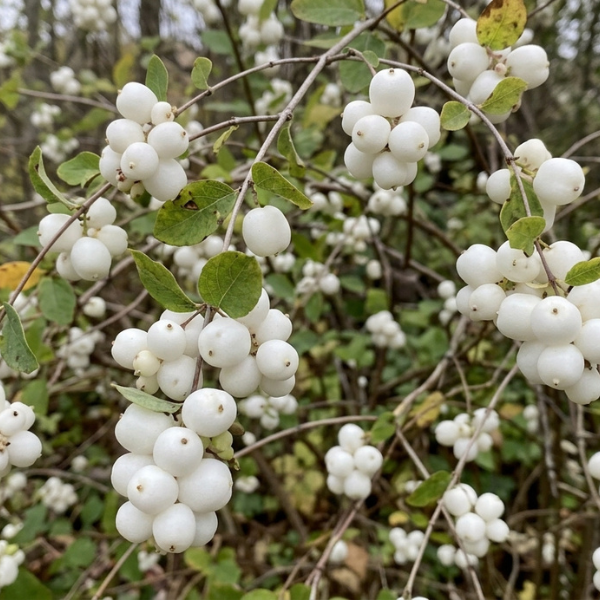
Lichen-bearing branches carry gray, green, and white. They pair best with materials that share that cool register. Western sword fern (Polystichum munitum) grounds the base and lets lichen read as the lighter layer above it. Snowberry (Symphoricarpos albus) echoes the pale tones of crustose lichen, its matte berries setting rhythm along a neighboring stem. Western red cedar (Thuja plicata) adds drape and tonal weight when its window opens later this autumn.
How We Gather Lichen-Bearing Branches
Lichen grows slowly. A branch carrying a full fruticose fringe may hold years of growth. We do not cut living branches for their lichen. Lichen-bearing material at Woody Shoots comes only from branches the wind has already brought down. After each autumn storm, we walk the 4.89-acre woodland and read what has fallen. The Washington Native Plant Society is a good place to deepen your knowledge of the native woodland these branches come from.
What we release depends on what the storm released first.
If you are new to working with lichen, or want to know what the latest storm has brought down, ask. Begin a seasonal conversation about current harvest windows, and we will tell you plainly what the woodland has offered.