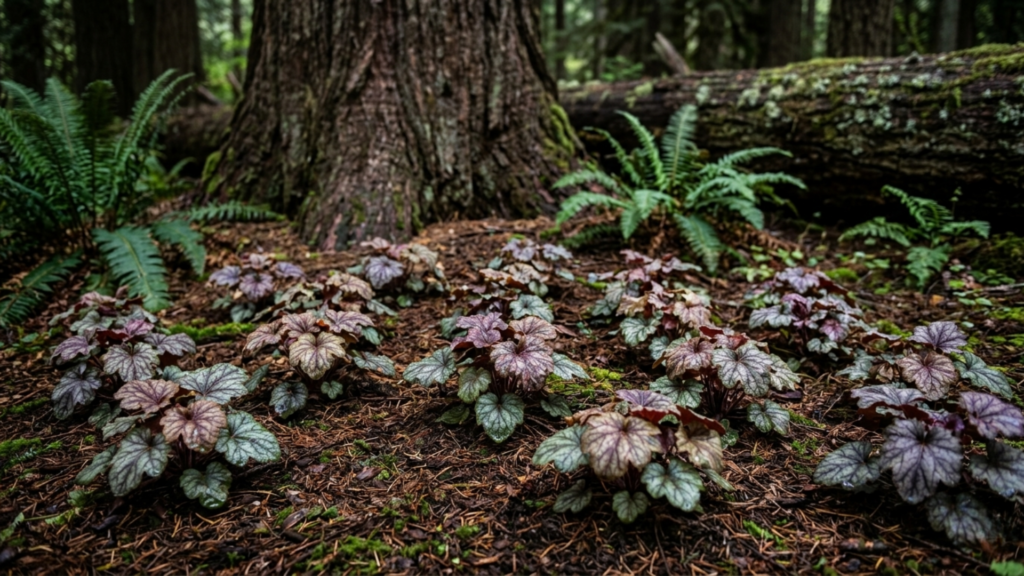
Tonal depth. A cultivated color field that grounds the woodland palette across every season.
Heuchera Foliage for Floral Designers
Heuchera foliage for floral designers offers something the native woodland palette alone cannot provide. It brings a sustained, tonal color field in smoke, copper, amber, and deep plum that grounds compositions across the full growing season. Known commonly as Coral Bells, Heuchera is grown at Woody Shoots as a cultivated companion — selected specifically for design intelligence rather than garden performance. As a result, the varieties Diane grows are chosen for foliage color, leaf texture, and compositional behavior rather than bloom. Furthermore, they are offered as a tonal bridge between the native branching, evergreen structure, and seasonal foliage that define the Woody Shoots palette.
Heuchera Foliage as a Cultivated Companion
Heuchera is not a PNW native in the same sense as Vine Maple or Cascara. Instead, it is a North American native genus grown at Woody Shoots as a deliberate cultivated companion — a material that extends the palette’s tonal range without compromising its woodland character.
Because native woodland materials tend toward green, gray, and seasonal warmth, they benefit from the addition of deeper, more sustained tonal foliage. Heuchera provides exactly that. Its smoke, plum, copper, and ember tones create a color field that no native species offers consistently across the growing season. In turn, that color field grounds compositions with a depth and richness that make every other material in the pull more legible and more intentional.
For further context on how grounding foliage functions in woodland compositions, see Woodland Grounding: A Designer’s Guide and the Woodland Behavior Glossary.
Seasonal Availability
Heuchera foliage is available from spring through autumn — one of the longest offering windows in the Woody Shoots seasonal calendar. Each seasonal stage offers a slightly different tonal register and foliage character.
Spring — March through May. New foliage emerges with the most vivid color of the year. Smoke, plum, and copper tones are richest at this stage. Furthermore, leaf texture is at its most refined — surfaces are smooth, edges are clean, and stems carry excellent length. This is the strongest design window for Heuchera foliage.
Summer — June through August. Foliage deepens and matures. Color remains strong but shifts toward richer, more saturated tones as temperatures rise. However, Woody Shoots closes in July and August— Heuchera summer material is not available. The summer pause allows the plants to recover and prepare for the autumn season.
Autumn — September through November. Foliage returns with the reopening of the season. Cool temperatures often deepen and enrich color further. As a result, autumn Heuchera carries some of the most distinctive tonal depth of the year — particularly in the smoke and deep plum varieties.
For current availability within these windows, visit the Seasonal Botanicals page or inquire directly.
Heuchera Foliage in Design — Behavior and Character
Heuchera foliage for floral designers carries a low, spreading, rosette-forming character that makes it one of the most versatile grounding materials in the Woody Shoots palette. Its gesture is quiet and settled — foliage sits and grounds rather than reaches or wanders. As a result, it anchors compositions with a tonal weight that structural branching alone cannot provide.
In terms of visual weight, Heuchera reads as medium to heavy — substantial enough to anchor a composition tonally, refined enough to avoid overwhelming lighter materials around it. The distinctive leaf surface — ruffled, veined, or smooth depending on the variety — creates a textural depth that reads differently from smooth cultivated foliage. Furthermore, the range of available tones means Heuchera can serve as either a warm or cool anchor depending on the variety selected.
Heuchera foliage for floral designers is particularly effective for tonal grounding in compote and low centerpiece work. It suits editorial compositions where foliage color rather than bloom carries the palette. Additionally, it works exceptionally well in installations where a sustained color field is needed across a large surface area, and in bridal palettes where deep plum or smoke foliage provides contrast against lighter blooms and native branching. For further context on how tonal foliage functions in woodland compositions, see Understory Light: A Designer’s Guide and Evergreen Structure: A Designer’s Guide.
Conditioning and Handling
Heuchera conditions reliably with straightforward handling appropriate to its foliage character. Begin with a warm water start — recut stems and hydrate for four to six hours before use. Because the leaves are broad and transpire readily, deep conditioning significantly extends performance in both studio and installation environments.
In the studio, Heuchera foliage holds well when kept cool and away from direct heat. Strip lower leaves to prevent bacterial buildup and keep water clean. Because the leaf surface can mark if compressed, store loosely and handle with care. The rosette form means stems are shorter than most branching materials — plan mechanics accordingly and use Heuchera as a grounding layer rather than a tall structural element.
For installation work, Heuchera performs best in water sources. Chicken wire and hand-tied structures both support its natural low form well. At peak spring stage, expect a vase life of seven to ten days with proper conditioning. Autumn material performs similarly with cool studio temperatures.
Ecology and Provenance
Heuchera is a North American native genus with approximately thirty-seven species native to woodland, prairie, and mountain habitats across the continent. At Woody Shoots, Heuchera varieties are grown as cultivated companions on the Dixon family land in Arlington — selected specifically for foliage color, design behavior, and tonal compatibility with the native woodland palette.
Because the Heuchera collection at Woody Shoots grows in the same cool, moist understory conditions as the native species alongside it, the foliage develops a depth and richness of tone that container-grown or greenhouse-forced material cannot replicate. Furthermore, growing conditions directly influence foliage character — the same variety grown in a warm, sunny nursery environment will read very differently from one grown in the filtered shade of a PNW woodland.
Terra Nova Nurseries in Canby, Oregon, is the leading Heuchera breeder in the Pacific Northwest — their work has significantly expanded the tonal range available to designers working with this genus. In addition, the Washington Native Plant Society documents the native Heuchera species that inform the ecological character of this cultivated collection.
Color and Texture Notes
The tonal range of the Heuchera collection at Woody Shoots spans smoke, copper, amber, deep plum, and ember — a color field that shifts with season, light, and the specific varieties available in any given pull.
Smoke varieties carry a cool, muted gray-green to gray-purple tone that reads as atmospheric and restrained in both natural and studio light. Copper and amber varieties bring warmth — a sustained ember tone that bridges the gap between native green foliage and the warm tones of autumn branching. Deep plum varieties provide the darkest, most saturated grounding — near-black foliage that creates strong tonal contrast against lighter blooms and pale native stems.
Texture varies by variety. Some leaves carry a ruffled, deeply veined surface that creates strong shadow play. Others are smoother and more refined — quieter in texture but no less distinctive in color. Consequently, Diane selects varieties for both tonal and textural compatibility with each specific pull rather than offering a fixed menu of cultivars.
Pairing Notes
Heuchera foliage pairs most naturally with materials that benefit from tonal grounding or contrast. Western Red Cedar tips provide the most natural evergreen companion — soft cascading green texture alongside deep plum or smoke Heuchera creates a composition with genuine woodland depth. Additionally, Vine Maple branching provides gestural contrast — expressive arching line above a settled Heuchera color field creates a composition that moves from ground to canopy in a single pull. In autumn, Cascara’s warm foliage alongside copper or ember Heuchera creates a sustained tonal warmth that no imported material replicates authentically. Furthermore, Snowberry’s pale berry punctuation against deep plum Heuchera is one of the most distinctive tonal combinations in the Woody Shoots autumn palette.
For full species documentation on these and other pairing materials, visit the Woodland Species Atlas and Species Index.
Notes From the Understory
Heuchera does not announce itself. Instead, it settles — a quiet color field at the base of a composition that makes everything above it more legible. Designers reach for Heuchera foliage when they want the arrangement to feel grounded, when the palette needs depth without heaviness, and when the smoke or ember of a single variety says more than a dozen imported blooms ever could.
Working With Woody Shoots
Diane grows Heuchera foliage for floral designers as a cultivated companion in the Arlington woodland throughout the spring through autumn seasons. Spring and autumn represent the most expressive design windows. Because Diane selects varieties specifically for design behavior rather than garden performance, the collection shifts gradually as new tonal ranges prove their value in pulled compositions. Reaching out one to two weeks ahead gives Diane the best opportunity to align available varieties with the designer’s palette direction.
For large-scale installations and events, Diane offers scouting consultations and scaled pulls designed around the vision rather than a standing inventory. Designers working at installation scale benefit most from early outreach — four to six weeks in advance gives the most room to plan tonal combinations across the full Heuchera collection.
Designers new to Heuchera foliage are welcome to reach out with questions. Diane will share which varieties are currently performing strongly and whether the available tones align with a specific project palette.