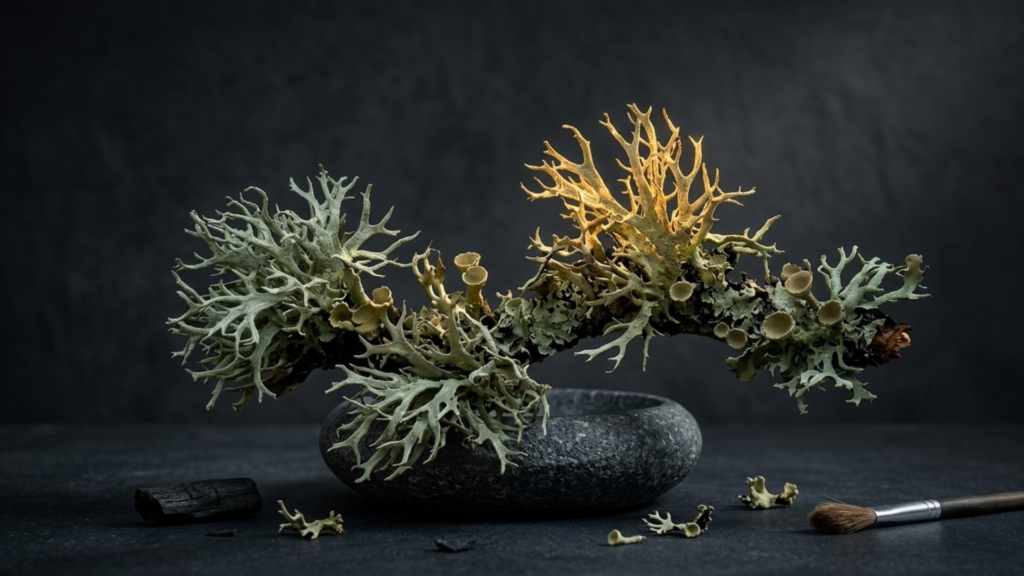
Woodland patina. The most singular and irreplaceable material the forest offers.
Lichen-Covered Branches for Floral Designers
Lichen-covered branches for floral designers offer something no catalog can supply. Each branch carries Evernia prunastri and native woodland lichens gathered from naturally fallen stormfall on the Dixon family land in Arlington, Washington. Because every branch arrives through stormfall rather than harvest, no two are identical. Furthermore, no quantity can be guaranteed in advance. That singularity is precisely the point — and precisely what makes this material irreplaceable.
What Lichen Covered Branches Are
Lichen is not a plant. Instead, it is a symbiotic organism — part fungus, part algae — that grows slowly on bark, wood, and stone over many years. Because lichen develops across decades rather than seasons, its presence on a branch signals genuine age, ecological health, and woodland authenticity. No nursery grows it. No wholesaler imports it reliably. Consequently, lichen-covered branches can only be gathered — never cultivated.
At Woody Shoots, lichen-covered branches are gathered exclusively from naturally fallen stormfall. This means no living branches are cut for lichen. Instead, Diane collects what the woodland offers after wind events, winter storms, and natural branch fall. As a result, every branch gathered reflects a specific moment of woodland life — singular, unrepeatable, and entirely honest.
For further context on how lichen functions as a design material, see the Woodland Behavior Glossary and Materials Guide.
Seasonal Availability
Lichen-covered branches are available on a stormfall basis rather than a fixed seasonal calendar. However, certain windows tend to produce the strongest material.
Autumn — September through November. Wind events and early seasonal storms begin producing stormfall. Moreover, lichen is at its most vivid green-gray tone in the cool, moist conditions of early autumn. This is often the most abundant gathering window of the year.
Winter — December through February. Winter storms produce the most significant stormfall events. In addition, cool temperatures preserve lichen condition exceptionally well. As a result, winter material tends to carry the strongest color, density, and surface character.
Early Spring — February through April. Late-season storms occasionally produce additional stormfall. Furthermore, the lichen condition remains strong through the cool, moist early-spring window.
Because availability is entirely stormfall-dependent, quantities cannot be guaranteed. Instead, Diane shares what the woodland has offered when designers inquire. Early outreach is strongly encouraged — lichen-covered branches move quickly once available.
For current availability, visit the Seasonal Botanicals page or inquire directly.
Lichen Covered Branches in Design — Behavior and Character
Lichen-covered branches for floral designers carry a quality that no other material provides. Each branch offers atmospheric texture, woodland patina, and a living surface that reads as genuinely aged and ecologically rooted. Furthermore, the lichen surface absorbs rather than reflects light — creating a soft, matte presence that grounds compositions without competing with other materials.
In terms of visual weight, lichen-covered branches read as medium to heavy — substantial enough to anchor large-scale installations, refined enough for intimate editorial tablework. The branch beneath the lichen carries its own expressive character — gestural line, natural arc, and distinctive bark texture that adds a second layer of design intelligence beyond the lichen surface itself.
Lichen-covered branches for floral designers are particularly effective for woodland-inspired installations where atmosphere defines the space. They suit editorial compositions where surface texture and material authenticity are the primary subjects. Additionally, they work exceptionally well in large-scale immersive events where the branch architecture creates the spatial narrative. Portland-based floral artist Françoise Weeks has pioneered the use of lichen, moss, and woodland materials in refined floral design — her work offers a useful creative reference for designers exploring this material territory for the first time.
For further context on how atmosphere and texture function in woodland compositions, see Understory Light: A Designer’s Guide and Evergreen Structure: A Designer’s Guide.
Handling and Care
Lichen-covered branches require minimal conditioning. However, careful handling preserves the lichen surface integrity that gives this material its design value.
Keep branches cool and away from direct heat — lichen desiccates quickly in warm, dry environments. In addition, avoid misting directly onto the lichen surface, as excess moisture can dislodge delicate lichen growth. Instead, lightly mist the air around the branches to maintain ambient humidity without direct contact.
In installation contexts, lichen-covered branches perform exceptionally well without water. They are among the most versatile dry-installation materials in the Woody Shoots palette. Because each branch is singular, handle with care — once the lichen surface is damaged, it cannot be restored. Store loosely and never compress or stack branches directly on top of one another.
Lichen-covered branches hold indefinitely in cool, dry installation contexts. Furthermore, they dry beautifully over time — the color shifts from vivid green-gray to a softer, more muted tone that carries its own quiet design value.
Ecology and Provenance
Lichen-covered branches at Woody Shoots carry Evernia prunastri — a foliose lichen common to the PNW woodland — alongside other native woodland lichen species that colonize the Dixon family land in Arlington. Because the land has been in the Dixon family and pesticide-free since 1982, the woodland has developed the ecological maturity that supports slow-growing lichen communities across its canopy and understory.
Furthermore, the stormfall-only gathering practice means no living branch is ever cut for lichen. Instead, every branch gathered reflects the woodland’s natural cycle — what falls is what is offered. As a result, designers who work with Woody Shoots lichen-covered branches are sourcing from a genuinely ecological practice rather than a harvested product line.
The Washington Native Plant Society documents the native woodland ecology that supports lichen communities across the Pacific Northwest. In addition, the Consortium of Lichen Herbaria offers deeper botanical context for designers interested in the ecological role of lichen in PNW forest systems.
Color and Texture Notes
Lichen-covered branches carry a tonal range that shifts with season, moisture, and the specific lichen species present on each branch. Consequently, no two branches read identically in composition.
Fresh autumn material carries vivid green-gray tones — cool, moist, and luminous in both natural and studio light. In contrast, winter material deepens toward a softer, more silvered tone as temperatures drop and moisture levels shift. Spring material returns to vivid green-gray as moisture levels rise again with the season.
Texture varies by branch. Some surfaces carry dense, layered lichen growth — a rich, almost topographic surface that creates strong visual depth. Others carry sparser growth — quieter, more atmospheric, and suited to compositions where subtlety is the primary design intention. Because each branch is gathered individually, Diane can discuss the specific character of available material when designers inquire.
Pairing Notes
Lichen-covered branches pair most naturally with materials that share their atmospheric, woodland-rooted character. Western Red Cedar tips provide the most grounding evergreen companion — soft cascading texture alongside the patinated lichen surface creates a composition entirely rooted in the PNW woodland. Additionally, Snowberry’s pale berry punctuation against lichen-covered branching is one of the most distinctive winter combinations in the Woody Shoots palette. In autumn, Vine Maple flame provides dramatic tonal contrast against the cool gray-green of the lichen surface. Furthermore, Red Osier Dogwood’s saturated winter line reads powerfully alongside lichen’s atmospheric texture.
For full species documentation on these and other pairing materials, visit the Woodland Species Atlas and Species Index.
Notes From the Understory
Lichen covered branches arrive on the woodland’s own terms — after wind, after storm, after the forest has decided what to release. Each branch is singular. The lichen pattern, color, and density are unique to every piece. Designers reach for lichen-covered branches when they want the arrangement to feel genuinely ancient — when surface, texture, and time matter more than any stem could say.
Working With Woody Shoots
Lichen covered branches for floral designers are gathered from naturally fallen stormfall in the Arlington woodland throughout the autumn through spring seasons. Because availability is stormfall-dependent, quantities and character vary with each gathering event. Furthermore, early outreach is strongly encouraged — lichen-covered branches are among the most sought-after and time-sensitive materials in the Woody Shoots palette.
For large-scale installations and events, Diane offers scouting consultations and scaled pulls designed around the vision. Designers working at installation scale are encouraged to reach out six to eight weeks in advance. That lead time gives the woodland the best opportunity to offer what the project needs.
Designers new to lichen-covered branches are warmly welcome to reach out with questions. Diane will share what the current stormfall has produced and whether the available material aligns with a specific project vision.