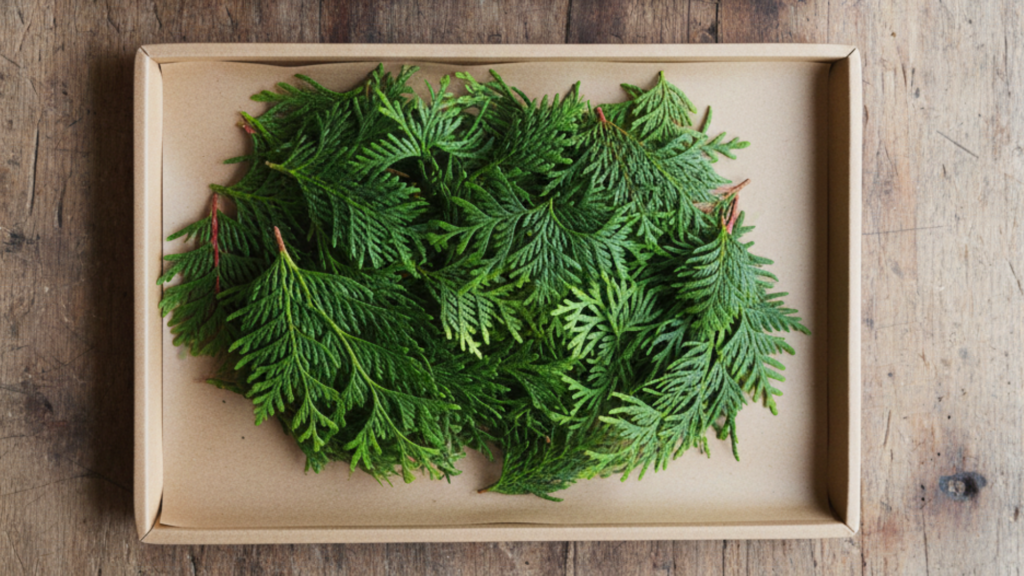
Evergreen breath. A soft, grounding texture from the winter understory.
Western red cedar tips for floral designers
Western Red Cedar tips are one of the most quietly essential materials in the Woody Shoots palette — a soft, atmospheric evergreen that designers reach for when they want depth without weight. The tips fan gently, hold moisture well, and bring a grounded, woodland calm to winter compositions. Because they are harvested from native cedar growing on the Dixon family land in Arlington, Washington, they behave differently from imported or farmed cedar — softer, more atmospheric, and less glossy. That distinction is felt in the hand before it is seen in the composition.
Seasonal Availability
Western Red Cedar tips are available from early autumn through late spring — one of the longest offering windows in the Woody Shoots seasonal calendar. Availability and quality shift across that arc in ways that matter for design planning.
Early Autumn — September through October. Tips are fresh, deeply hydrated, and a rich warm green. This is an excellent window for early seasonal work where color warmth and vitality are priorities.
Late Autumn — November. Color deepens, and the tips become more resinous, increasing longevity significantly. This is the beginning of the cedar’s strongest design window.
Winter — December through February. Peak quality. Cool-toned green, soft velvety texture, and exceptional longevity make winter the most distinctive offering window for this species. No other season produces the same atmospheric depth.
Early Spring — February through April. New growth begins, and tips remain fully usable, though the emerging growth is more delicate than the winter material. A transitional window with its own quiet character.
Late Spring — April through May. A soft chartreuse flush appears as new growth extends. Best for gentle, textural work where a lighter tonal register serves the composition.
Current seasonal woodland materials → Seasonal Botanicals.
Design Behavior
Western Red Cedar tips carry a soft, cascading, natural fan shape that makes them among the most versatile grounding materials in the Woody Shoots palette. Their gesture is gentle and atmospheric rather than architectural — they support and soften rather than define and direct.
In terms of visual weight, cedar tips read as light to medium — supportive without heaviness, present without dominance. Their matte green surface with cool undertones absorbs rather than reflects light, which is why they photograph so well in editorial and installation contexts. They add depth to a composition without introducing visual noise.
Cedar tips are particularly effective for winter installations, editorial compositions needing soft texture, grounding minimal palettes, and large-scale textural work where the material needs to carry significant visual area without competing with structural stems. For holiday work, they bring an authentic woodland quality that reads as restrained and atmospheric rather than commercially seasonal.
For further context on how evergreen grounding materials function in composition, see Evergreen Structure: A Designer’s Guide and Woodland Grounding: A Designer’s Guide.
Conditioning and Handling
Western Red Cedar tips condition reliably and hold exceptionally well with straightforward handling. Keep cut ends wrapped in moist paper and store cool — avoid direct heat, which accelerates needle drop. Misting lightly during long installations extends freshness without introducing excess moisture to the structure.
In the studio, cedar tips hold color and moisture extremely well. Because they can flatten if compressed, store them loosely rather than bundled tightly. The resin scent is subtle and clean — present enough to signal authenticity without overwhelming other materials in the composition.
For installation work, cedar tips drape beautifully and work well in chicken wire and hand-tied structures. Avoid overhandling — needle bruising is the primary quality risk, and it is easily avoided by working with the material’s natural fan shape rather than against it.
Longevity. Fresh tips perform well for ten to fourteen days with proper conditioning. In installation contexts without a water source, expect five to seven days depending on ambient humidity and temperature.
Ecology and Provenance
Western Red Cedar is native to western Washington, where it thrives in Snohomish County’s moist lowland forests and shaded understories. The cedar at Woody Shoots grows wild on the Dixon family land in Arlington — a property in the Dixon family and pesticide-free since 1982, reflecting true local provenance shaped by decades of natural woodland ecology.
Because PNW-grown Thuja plicata develops in cool, moist, shaded conditions, it produces cool-toned matte needles, soft flexible fans, and natural hydration retention that imported or greenhouse-grown cedar cannot replicate. The subtle resin scent reads as woodland rather than holiday retail — a distinction that designers working in the atmospheric and editorial space notice immediately.
The Washington Native Plant Society documents the full ecology and native range of Thuja plicata for designers who want deeper botanical context behind this species.
Color and Texture Notes
The tonal character of Western Red Cedar tips shifts gradually across the seasonal arc — a quality that matters for designers building compositions with careful attention to color temperature.
In early autumn, the tips read as deep green with a slightly warm undertone. Through winter, they shift to a cool green with a velvety, matte surface that absorbs studio and natural light beautifully. Early spring brings a lighter tonal register as new growth begins to extend. Late spring introduces a gentle chartreuse flush at the tips — a distinctly different material character suited to compositions where the lighter tonal register serves the seasonal story.
Texture throughout the arc is soft, pliable, and layered — fans that move naturally and hold their form without mechanical support.
Pairing Notes
Western Red Cedar tips pair most naturally with materials that contrast or complement their grounding evergreen presence. Snowberry softens the green with pale berry punctuation and quiet branching. Red Osier Dogwood introduces the contrast of saturated line against soft texture — one of the most effective winter pairings in the Woody Shoots palette. Cascara offers complementary winter foliage with a different gestural register — upright and architectural where cedar is cascading and soft.
For full species documentation on these and other pairing materials, visit the Woodland Species Atlas and Species Index.
Notes From the Understory
Cedar holds the winter light differently — soft, matte, and steady.
Cut in the cold months, the tips feel almost luminous, carrying the scent of rain and wood.
Designers reach for Western Red Cedar when they want the arrangement to breathe,
to feel grounded, to feel like the forest itself exhaled.
Working With Woody Shoots
Western Red Cedar tips are harvested in small batches from the Arlington woodland, bundled in breathable kraft rather than plastic, and available for pickup in the Arlington–Stanwood corridor. Because every harvest is cut to order, reaching out one to two weeks ahead of an installation gives the woodland the most room to align with project timing.
Designers new to working with cedar tips are welcome to reach out with questions — Diane will share what the current season is offering and whether the timing aligns with a specific project window.