Oakmoss After the First Storms: PNW Woodland Atelier Floral Materials
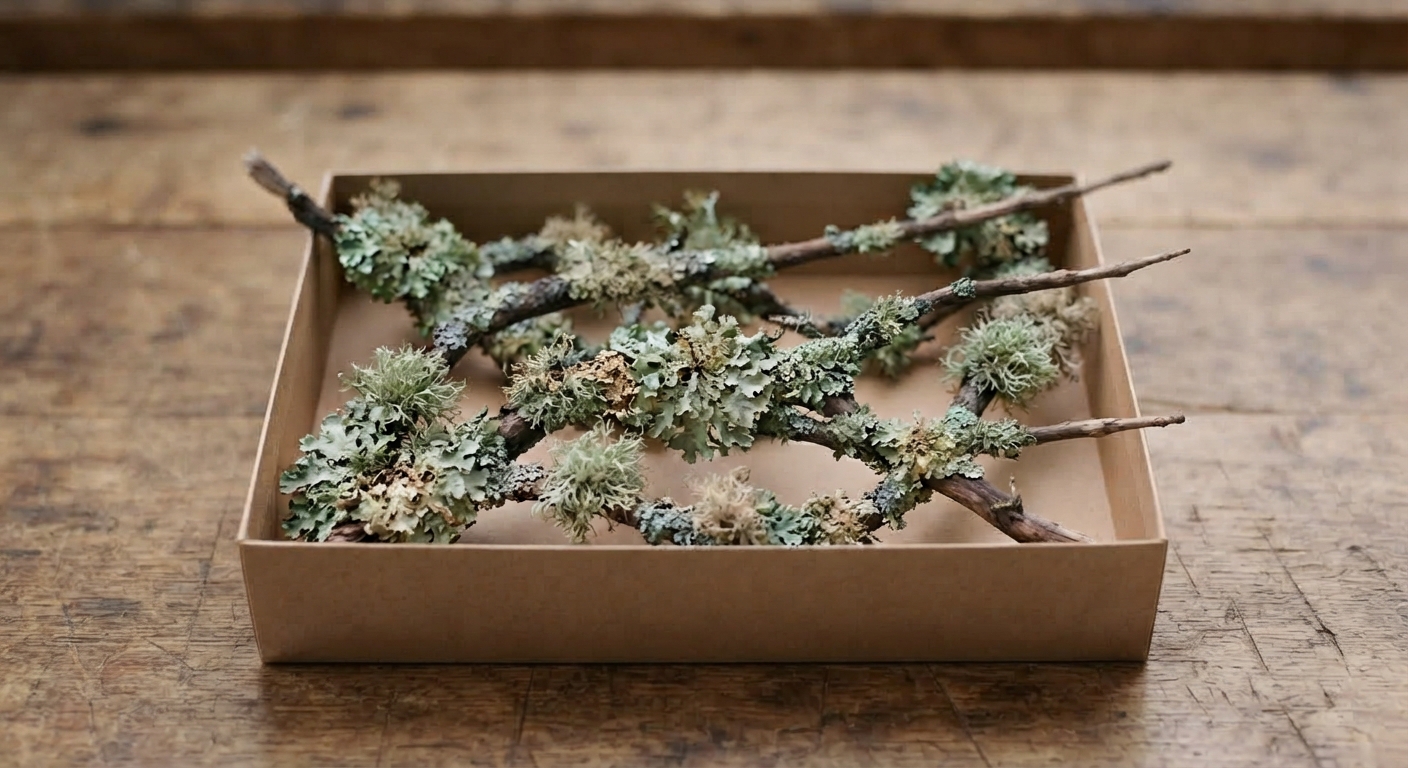
Oakmoss lichen (Evernia prunastri) is never cut. It comes down on its own. The woodland has been releasing it steadily through the past weeks of wind — pale grey-green above, whitish beneath, softly branching. It carries texture without carrying tonal weight.
That combination is uncommon. Most materials that bring texture also bring mass, and among PNW woodland atelier floral materials, this is one of the few that arrives already finished. Nothing to condition. Nothing holding a clock.
Oakmoss Among PNW Woodland Atelier Floral Materials
The lobes are roughly five millimeters across, branching and re-branching without a dominant direction. There is no line in it and no gesture — that is the point. Oakmoss does not move the eye through a composition. It slows the eye where it lands.
The two-tone surface does quiet work. Turned one way the piece reads pale green; turned the other, nearly white. In low autumn light that variation registers as depth rather than as color.
Oakmoss Among PNW Woodland Atelier Floral Materials
The lobes are roughly five millimeters across, branching and re-branching without a dominant direction. There is no line in it and no gesture — that is the point. Oakmoss does not move the eye through a composition. It slows the eye where it lands.
The two-tone surface does quiet work. Turned one way the piece reads pale green; turned the other, nearly white. In low autumn light that variation registers as depth rather than as color.
The Seasonal Window for PNW Woodland Materials
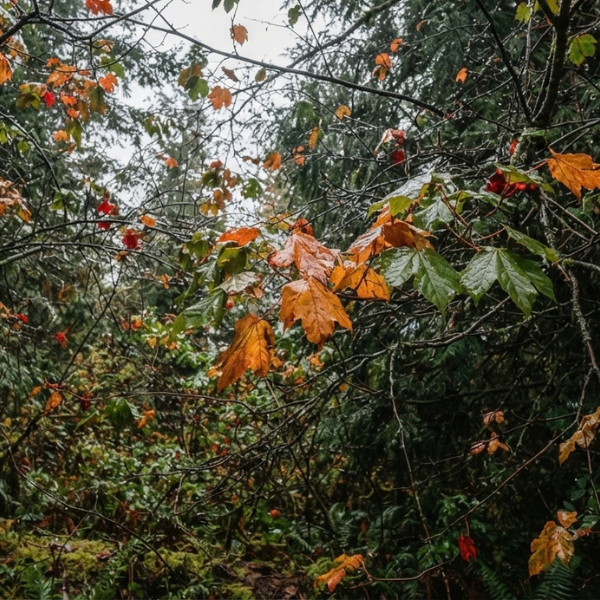
The window opens with the first real storms and runs through to spring. It is not a harvest window in the ordinary sense, because nothing is being harvested. What the wind brings down is what there is.
The lichen itself is abundant on the west side of the Cascades, most of all in lowland hardwood. The storms decide only when it arrives.
Some weeks that is a great deal. Some weeks it is very little. Gathering happens on the daily walk, and what accumulates through autumn is simply what the weather decided.
What It Allows You to Do
Oakmoss lets a designer introduce texture late — after the structure is set, after the line is placed. It tucks into the base of a composition without competing for the space the branching materials have already claimed.
It also removes a constraint. Dry, it does not wilt and it does not need water. For installation work built over two days, that matters more than any quality it has.
It asks one thing in return. Kept in light, the gray-green fades toward straw over the weeks, and it does not come back. It is held in the dark until it is wanted.
Pairing with Native Foliage for Floral Composition
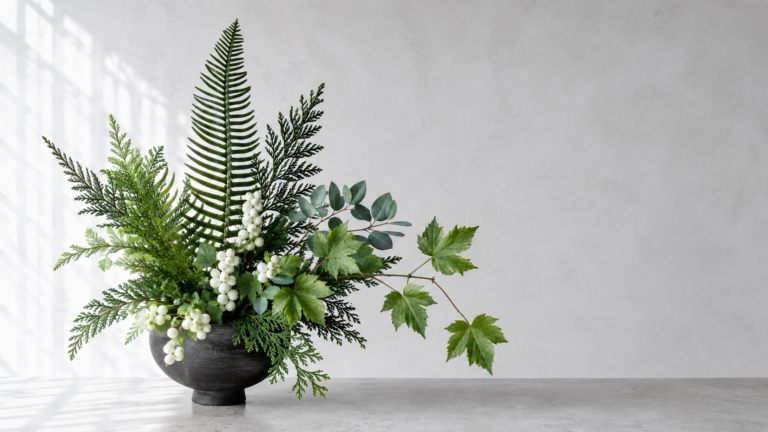
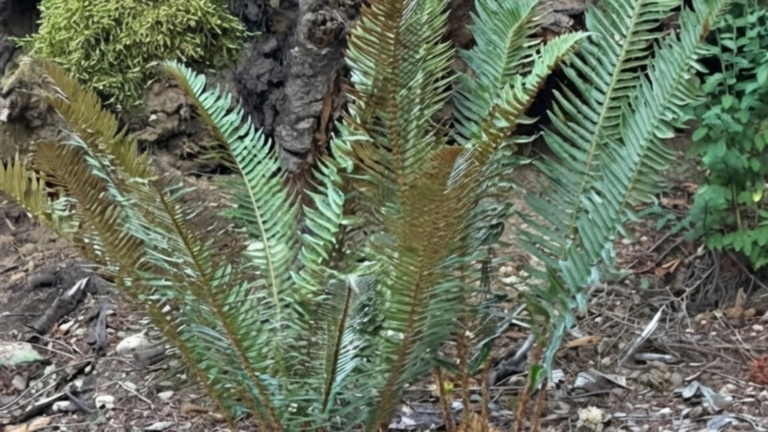
Western red cedar (Thuja plicata) grounds with tonal weight; oakmoss sits above that weight and breaks its uniformity. Western sword fern (Polystichum munitum) layers depth through its fronds, and oakmoss fills the shadow between them.
With snowberry (Symphoricarpos albus), the pairing is tonal — matte white berries against pale gray-green, both of them light, neither of them bright.
Gathered, Not Harvested
Oakmoss is an epiphyte. It takes nothing from the tree it grows on; it uses the bark as a place to sit. When it comes down, it comes down because the branch let go, not because anything was taken.
On a 4.89-acre hillside riparian woodland in the Arlington–Stanwood corridor, that means the practice is a walk and a basket. It is the only material here that asks nothing of the woodland at all.
Every other material has a cut behind it, and a reason for that cut. Oakmoss is the plainest case of how harvest practice shapes what reaches a designer’s bench.
What is gathered this autumn is shared with a small circle of six to ten designers. The Species Atlas holds the fuller picture of what the woodland carries through the cold months.
When December dates and palettes begin taking shape, begin a seasonal conversation.