Evergreen Structure: A Designer’s Guide
Evergreen structure is the woodland’s year-round architecture — the form, mass, and spatial presence that remain when deciduous materials retreat. For floral designers, understanding evergreen structure reveals how the forest holds tone, line, and emotional weight through the quiet seasons. Unlike deciduous materials that arrive and depart with the growing cycle, evergreen structure is always present — anchoring the woodland’s spatial language and providing the compositional backbone that makes seasonal materials readable.
What Evergreen Structure Is
Evergreen structure is not simply the presence of green in winter. Instead, it is the accumulated architectural form of plants that hold their foliage year-round — building mass, layering branching, and developing a spatial density that shapes the woodland’s character across every season.
Because evergreen species grow slowly, their forms are deliberate and durable. Each layer of branching represents years of incremental growth rather than a single season’s flush. As a result, evergreen materials carry a sense of permanence and intention that deciduous materials — however beautiful in their seasonal moments — cannot replicate. This quality is precisely what makes evergreen structure so valuable in design. Furthermore, it is what makes native evergreen materials irreplaceable for designers building compositions with genuine woodland character.
How Evergreen Architecture Forms in the Woodland
Evergreen structure develops through three overlapping forces — each leaving its signature on the plant’s final architectural form.
Shade as a Sculptor. Deep understory shade slows growth and concentrates form. Rather than reaching rapidly toward light, shade-grown evergreens develop compact, layered branching and quiet density — a structural patience that translates directly into compositional mass and depth. The Understory Light: A Designer’s Guide explores how light shapes this process in detail.
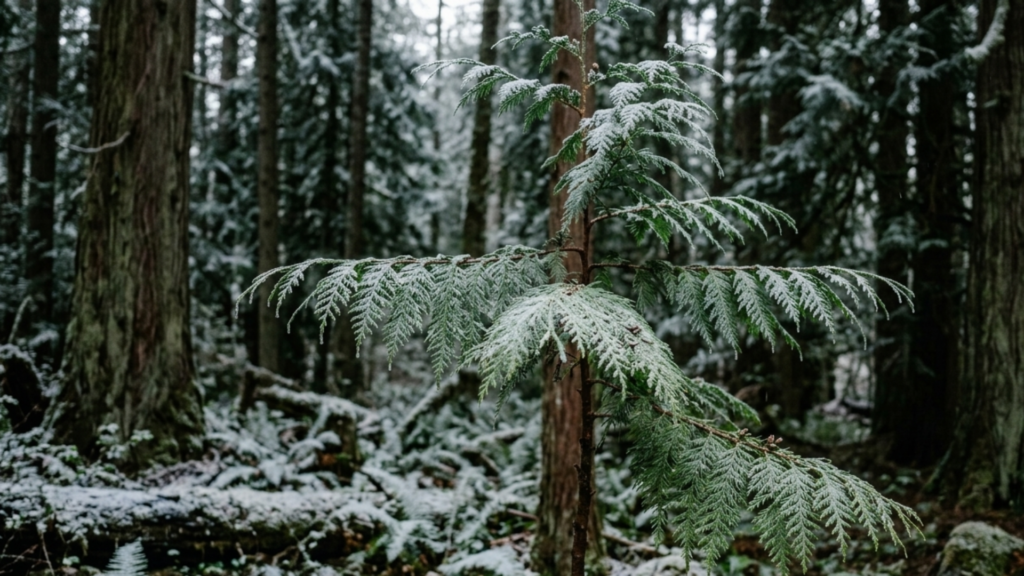
Winter Influence. Snow load, wind, and sustained moisture shape evergreen form across years of cold-season pressure. In particular, the Western Red Cedar materials at Woody Shoots carry the most visible record of winter force — their layered drape and arcing branch tips shaped by seasons of snow weight and coastal wind rather than a growing tunnel or greenhouse.
Slow Growth, Strong Form. Evergreen species develop structure that accumulates rather than erupts. Each branching layer builds on the last, creating a durable architectural presence that anchors the woodland. In turn, this accumulation gives evergreen materials a visual weight and spatial authority that seasonal materials rely on for context and contrast.
The Designer’s Lens — Reading Evergreen Structure
Evergreen structure reveals how a plant holds space — how it anchors a composition, carries tone, and creates continuity through the seasons. Designers who learn to read evergreen form gain access to a material quality that no catalog description captures adequately.
Mass is the first quality to read. Where an evergreen plant has developed density — layered branching, overlapping foliage planes, accumulated volume — it offers compositional weight that grounds movement and gives lighter materials something to lean against. Persistent line is the second quality. Unlike the seasonal lines of deciduous branching, evergreen line remains constant — providing the quiet continuity that holds a composition together as other materials change around it. Winter tone is the third. The deep greens, blue-greens, and warm ochres of evergreen foliage set the emotional temperature of cold-season compositions in a way that no imported material can replicate authentically.
Together, these three qualities — mass, line, and tone — make evergreen structure the foundation of woodland design intelligence. Moreover, understanding them transforms sourcing from a search for greenery into a search for architectural intention.
Applying Evergreen Structure in Design
Evergreen structure works best when treated as the compositional foundation rather than the finishing layer. Rather than adding evergreen materials at the end to fill space, designers who understand evergreen architecture place it first — establishing the mass, line, and tone that all other materials will read against.
Strong evergreen mass anchors compositions that include significant movement. In turn, movement materials rely on evergreen grounding to prevent them from reading as unresolved or floating. The Movement: A Designer’s Guide and Woodland Grounding: A Designer’s Guide explore these relationships in depth.
Layered evergreen branching also creates depth in ways that single-plane materials cannot. By placing evergreen materials at varying heights and angles within a composition, designers build a spatial complexity that mirrors the woodland’s own vertical structure — canopy to understory to groundplane — and gives the finished work a sense of having grown rather than been arranged.
Architectural branches for floral design →
Species That Express Evergreen Structure Well
Some species carry evergreen structure more clearly than others. The following materials from the Woody Shoots palette are particularly useful for designers learning to read and work with architectural evergreen form:
- Western Red Cedar — layered drape and arcing branch tips shaped by years of winter weight
- Leucothoe — arching evergreen branching with seasonal color shift from green to burgundy
- Evergreen Huckleberry — fine-textured branching with persistent small-leaf foliage and quiet density
- Young Western Red Cedar — small-scale cedar architecture with restrained branching and consistent cool-green presence
- Salal — broad, leathery foliage with strong horizontal branching and deep green tone
- Oregon Grape — architectural compound foliage with strong winter color and structural presence
For full species behavior documentation, visit the Woodland Species Atlas and Seasonal Botanicals.
The Species Index organizes the full palette by behavioral group.
Evergreen structure is the woodland’s quiet backbone — the form that holds when the forest goes still. When designers understand year-round structure, they gain a deeper sense of how tone, mass, and architecture shape a composition’s emotional weight. The evergreen is not background. Instead, it is the grammar that makes everything else legible.
Continue to Woodland Grounding: A Designer’s Guide to explore how evergreen structure relates to compositional grounding and weight.
For the regional ecological context behind these native species, see research from the USFS Pacific Northwest Research Station.