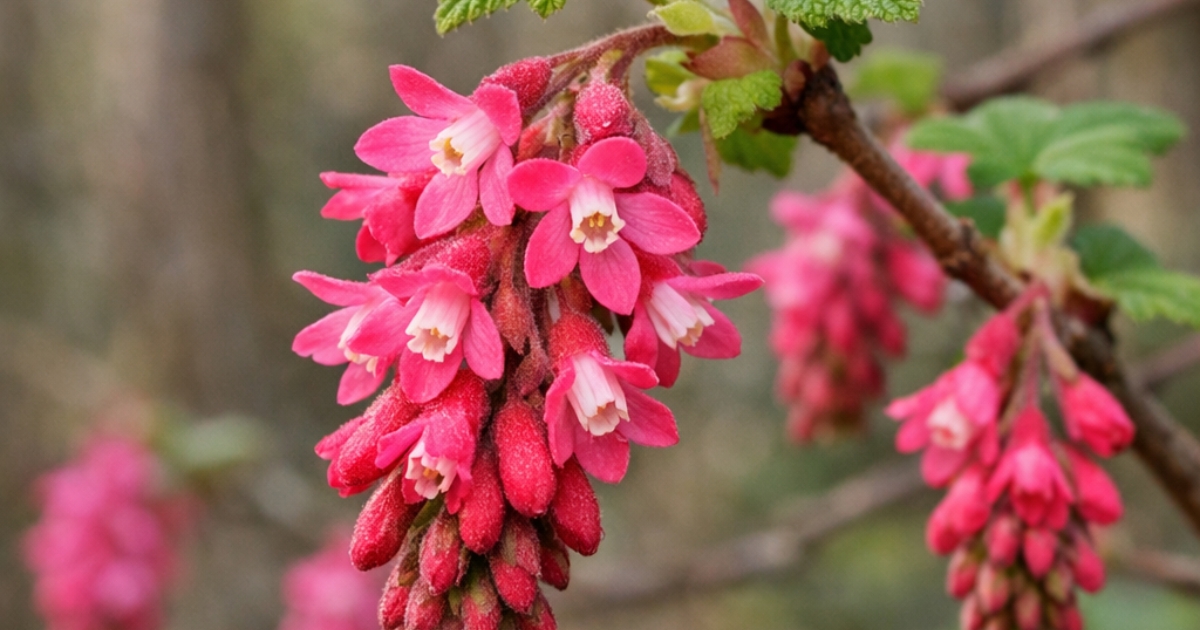
Early‑spring blush. A soft, pendulous gesture from the woodland edge.
Red Flowering Currant for Floral Designers
Red Flowering Currant — known botanically as Ribes sanguineum — is one of the Pacific Northwest woodland’s most vivid early-spring signals. For floral designers, it brings movement, delicacy, and a sense of awakening. Its arching stems and drooping racemes offer a natural, expressive line that reads as true woodland spring. Because it blooms before most other native plants have even begun to leaf out, Red Flowering Currant occupies a seasonal moment that no other material can fill.
Seasonal Availability
Red Flowering Currant offers a compressed but richly expressive availability window from late winter through late spring. Each stage has its own distinct design character.
Late Winter — February. Buds swell, and color begins to show. Stems carry a quiet tension at this stage — the material is architectural and anticipatory, holding the promise of what is about to open. This window pairs naturally with the late-winter Red Osier Dogwood palette.
Early Spring — March. The best harvest window. Racemes are partially open, stems are flexible, and the color is at its most saturated. This is Red Flowering Currant at its most expressive — soft blush against still-bare woodland branching. Because this window is brief and weather-dependent, designers who plan access what no catalog can offer.
Mid Spring — April. Full bloom has emerged. Racemes become more delicate at this stage and vase life shortens. Best for compositions where the full-bloom character serves the design intention and the shorter window is manageable.
Late Spring — May. Bloom is mostly finished, and foliage becomes lush. Best used for greenery and gesture work where the fresh leaf rather than the raceme carries the composition.
For current availability within these windows, visit the Seasonal Botanicals page or inquire directly.
Design Behavior
Red Flowering Currant carries a softly arching, naturally curving line that makes it one of the most gesture-forward materials in the early-season palette. Its movement is pendulous and expressive — racemes hang with a quiet confidence that gives compositions a sense of natural weight and seasonal authenticity.
In terms of visual weight, Red Flowering Currant reads as light and airy — delicate rather than substantial, expressive rather than anchoring. Its matte petals and soft blush tones photograph beautifully with gentle shadow play that rewards both natural and studio light. This is a material that makes its presence felt through gesture and color rather than volume or structure.
Red Flowering Currant is particularly effective for early-spring editorial work where seasonal authenticity is the subject, ikebana-inspired compositions where a single arcing stem carries the piece, bridal palettes needing soft natural color without the commercial softness of cultivated bloom, and gesture-driven arrangements where the raceme’s pendulous movement leads the composition. For further context on how movement and gesture function in woodland compositions, see Movement: A Designer’s Guide.
Conditioning and Handling
Red Flowering Currant conditions reliably when handled with care appropriate to its delicacy. Begin with a warm water start — recut stems and hydrate for four to six hours before use. Keep racemes above the waterline during conditioning to protect the bloom clusters from premature deterioration. Avoid cutting after hard freezes, which compromises both stem integrity and raceme quality.
In the studio, Red Flowering Currant is sensitive to heat — keep it cool and away from direct heat sources, which accelerate petal drop. Because petals can drop if overhandled, place stems once rather than adjusting repeatedly. Leaves remain fresh and expressive when properly hydrated throughout the vase life.
For installation work, Red Flowering Currant performs best in water sources — chicken wire and hand-tied structures both support its natural movement well. Avoid floral foam entirely, as stems are too slender and delicate for foam mechanics. At its best stage — buds showing color with the first florets open — expect a vase life of four to six days with proper conditioning.
Ecology and Provenance
Red Flowering Currant is native to western Washington, where it thrives along Snohomish County’s bright woodland edges and early-spring understories. The Ribes sanguineum at Woody Shoots was sourced through the Snohomish Conservation District, reflecting true local provenance rather than ornamental cultivar behavior — a distinction that matters for designers seeking materials with genuine ecological character.
Because PNW-grown Ribes sanguineum develops in cool, moist woodland edge conditions, it produces saturated red-pink racemes, expressive pendulous clusters, flexible early-season stems, and the soft matte bloom that designers recognize as authentic to this region. Furthermore, its color reflects actual early-spring light conditions rather than greenhouse forcing — a quality that designers in the atmospheric and editorial space notice immediately.
The Washington Native Plant Society documents the full ecology and native range of Ribes sanguineum for designers who want deeper botanical context behind this species.
Color and Texture Notes
The tonal character of Red Flowering Currant shifts across its seasonal window in ways that matter for designers building compositions with careful attention to color temperature.
In late winter, stems carry swelling buds with the first blush of color emerging — cool-toned and restrained, the material is architectural and anticipatory. Early spring brings the most distinctive moment — saturated red-pink racemes against flexible arching stems, a combination that reads as luminous and expressive in both natural and studio light. Through mid-spring, the bloom reaches full expression but becomes more delicate. By late spring, the foliage is lush, and the bloom is past — a different material character suited to different compositional needs.
Texture throughout the arc is soft, matte, and delicate — pendulous bloom clusters that reward a light hand and careful placement.
Pairing Notes
Red Flowering Currant pairs most naturally with materials that share its early-season character or provide complementary contrast to its soft, arcing gesture. Osoberry is the most natural companion — the two species share an almost identical seasonal window and together create a composition that feels entirely rooted in the PNW woodland edge. Snowberry branching softens the palette with quiet structural presence and pale punctuation. Vine Maple buds provide contrasting line — more architectural where Red Flowering Currant is soft, more directional where it wanders.
For full species documentation on these and other pairing materials, visit the Woodland Species Atlas and Species Index.
Notes From the Understory
Red Flowering Currant is one of the first to wake.
The racemes hang with a quiet confidence — a soft blush against the still-bare branches of late winter.
Designers reach for it when they want the arrangement to feel like the season is turning,
like the light has shifted, like something is beginning.
Working With Woody Shoots
Red Flowering Currant is harvested in small batches from the Arlington woodland during its brief February through April window within the broader September through May season. Because the peak harvest window is weather-dependent and can shift by weeks depending on the year’s temperature pattern, reaching out one to two weeks ahead of a project gives Diane the best opportunity to align the harvest with the designer’s dates.
Designers planning early-spring editorial work or events in the March window are particularly encouraged to reach out early — Red Flowering Currant at peak bloom is one of the most time-sensitive materials in the Woody Shoots calendar.