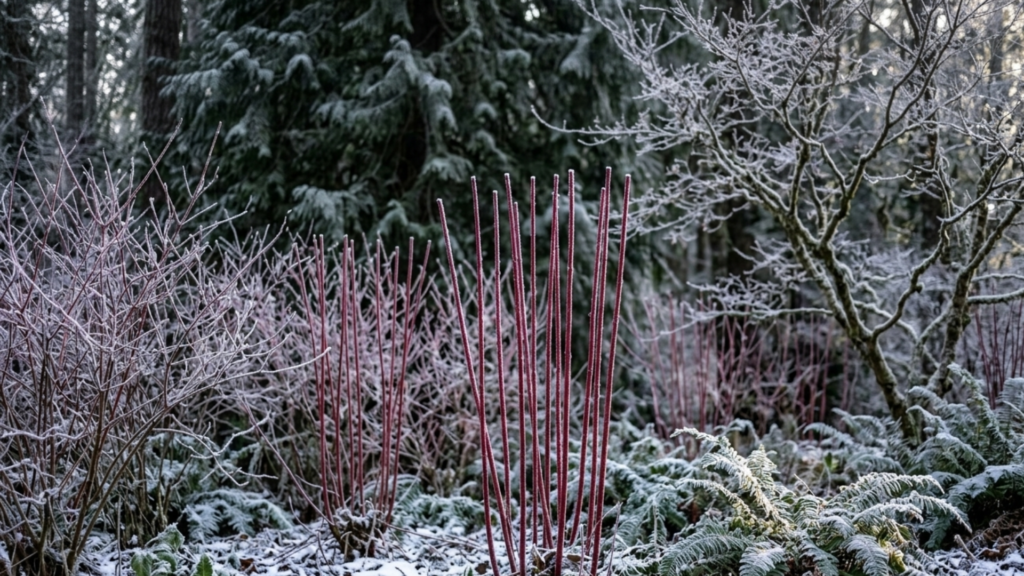
Ink‑red winter line. A clean, architectural stroke against the quiet field.
Red Osier Dogwood Stems
For Floral Designers
Red Osier Dogwood is the Pacific Northwest woodland’s most distinctive winter stem. Known botanically as Cornus sericea, it is sometimes called Red Twig Dogwood. For floral designers, it brings a clean, architectural line and saturated red color. No imported material replicates that combination authentically. PNW-grown Cornus sericea develops in cool, moist riparian conditions. As a result, it produces deeper winter reds and cleaner line. The sculptural dormancy it carries is something designers recognize immediately as genuinely native to this region.
Seasonal Availability
Red Osier Dogwood offers one of the most sustained availability windows in the Woody Shoots seasonal calendar. The season runs from early autumn through late spring. The material shifts meaningfully across that arc in ways that matter for design planning.
Early Autumn — September through October. Foliage shifts from green to russet and the stems remain muted in color. This is a transitional window — useful for designers building compositions that bridge summer and winter palettes.
Late Autumn — November. Leaves drop and color begins to concentrate along the younger stems as the plant enters dormancy. The emerging line quality becomes visible, and the material starts its shift toward its most distinctive winter character.
Winter — December through February. Peak saturation. Deep red, clean line, and sculptural silhouette define this window. It is the most distinctive offering in the entire Woody Shoots seasonal calendar. No other PNW source provides this curated winter-line palette for designers.
Early Spring — February through April. Bud swell adds a quiet tension to the stems — red line with the first green hints of returning growth. This transitional moment has its own compositional character distinct from both winter and spring.
Late Spring — April through May. Color softens as stems leaf out. Best used for lush, textural work where the fresh green foliage rather than the winter stem color carries the composition.
For current availability within these windows, visit the Seasonal Botanicals page or inquire directly.
Design Behavior
Red Osier Dogwood carries a straight, confident, architectural line that makes it one of the most structurally decisive materials in the winter palette. Its gesture is minimal and intentional rather than expressive or wandering — it does not arc or reach but stands with quiet assertion, defining space rather than moving through it.
In terms of visual weight, Red Osier Dogwood reads as medium — substantial enough to anchor a composition structurally, light enough to function as gesture rather than mass. Its matte-to-satin red surface photographs with strong shadow line and high contrast against neutrals — a quality that makes it particularly effective for editorial work where the stem itself is the subject.
Red Osier Dogwood is particularly effective for winter editorial compositions where line carries the piece, ikebana-inspired arrangements where a single deliberate stroke defines the work, installations needing clean verticals and structural clarity, and bridal palettes seeking one intentional stroke of saturated winter red. For minimal arrangements, it brings the luxury of restraint — a material that asks for space rather than company.
For further context on how line and structure function in woodland compositions, see Evergreen Structure: A Designer’s Guide and the Woodland Behavior Glossary.
Conditioning and Handling
Red Osier Dogwood conditions reliably and holds exceptionally well with straightforward handling. Begin with a warm water start for winter stems — recut at a fresh angle and hydrate before use. Recutting every two to three days extends vase life significantly for longer projects. Strip lower nodes for clean water and optimal uptake.
In the studio, Red Osier Dogwood holds its color exceptionally well indoors — the deep winter red is stable and does not fade quickly under studio light or warmth. When in leaf, minimal leaf drop occurs with proper conditioning. Water stays clear with proper stem stripping, which also improves uptake and reduces bacterial buildup.
For installation work, Red Osier Dogwood performs excellently in chicken wire and is strong enough to function as an armature material for larger structural builds. Younger wood is flexible and responsive — older wood is more rigid and better suited to compositions requiring a fixed vertical line. Bare stems perform well for ten to fourteen days with proper conditioning. Leafed stems last five to seven days.
Ecology and Provenance
Red Osier Dogwood is native to western Washington, where it grows along Snohomish County’s riparian edges and lowland wetlands. The Cornus sericea at Woody Shoots was sourced through the Snohomish Conservation District, reflecting true local provenance rather than ornamental cultivar behavior — a distinction that matters significantly for the stem’s design character.
Because PNW-grown Cornus sericea develops in cool, moist riparian conditions, it produces deeper winter reds intensified by cold nights, longer, cleaner stems shaped by moist soils, expressive nodes that read beautifully in composition, and reliable regrowth after coppicing that sustains the harvest cycle season after season. Furthermore, its color saturation reflects actual cold-season conditions rather than greenhouse forcing — a quality that designers in the atmospheric and editorial space notice immediately.
The Washington Native Plant Society documents the full ecology and native range of Cornus sericea for designers who want deeper botanical context behind this species.
Color and Texture Notes
The tonal character of Red Osier Dogwood shifts gradually across its long seasonal arc — a quality that rewards designers who understand each stage rather than treating the species as a single seasonal offering.
In early autumn, the stems show russet tones with fading green and soft burgundy undertones. This creates a transitional palette suited to designs that bridge the seasons.
Through winter, the color deepens into saturated red with ink‑line clarity and matte bark. This becomes the most graphic and editorial moment in the species’ year.
Early spring brings chartreuse bud tension against the still‑red stems. This combination carries winter’s deliberateness and spring’s returning energy.By late spring, the red softens under fresh green leafing — a different material character entirely.
Texture throughout the arc is smooth bark with a subtle sheen — nodes add rhythm and visual punctuation that give the stem its distinctive graphic quality in both intimate and large-scale compositions.
Pairing Notes
Red Osier Dogwood pairs most naturally with materials that contrast or complement its clean winter line and saturated color. Western Red Cedar tips provide the most grounding counterpoint — soft, cascading evergreen texture against decisive red line, one of the most effective winter pairings in the Woody Shoots palette. Snowberry branching softens the composition with pale punctuation and quiet structural presence. Vine Maple provides contrasting gesture — expressive and wandering where Red Osier Dogwood is straight and deliberate. Osoberry serves as the natural early-spring companion as the season transitions — its soft arcing movement bridging winter’s architectural line into spring’s ephemeral character.
For full species documentation on these and other pairing materials, visit the Woodland Species Atlas and Species Index.
Notes From the Understory
In the cold months, the stems burn brighter.
Color concentrates where the light is scarce.
Cut in winter, Red Osier Dogwood carries a kind of resolve — a clean, unwavering line that holds its own in the quiet season.
Designers reach for it when they want the arrangement to feel deliberate.
Working With Woody Shoots
Red Osier Dogwood is harvested in small batches from the Arlington woodland throughout the September through June season, with quantities varying with the weather and the natural coppice cycle. Because coppicing — cutting stems close to the ground to encourage vigorous new growth — is how Diane manages the harvest sustainably, availability is shaped by both the season and the plant’s regrowth rhythm. Reaching out one to two weeks ahead of an installation gives the most room to align the harvest with project timing.
Designers planning winter editorial work or installations in the December through February window are particularly encouraged to reach out early — peak-saturation Red Osier Dogwood is one of the most sought-after materials in the Woody Shoots winter calendar.