Acer circinatum in Samaras: What Seasonal Truth Means for Designer Composition This Spring
Acer circinatum — native vine maple — gives designers something commercial stems cannot: seasonal truth that carries place, time, and structural intention into a composition. Its samara-heavy spring branches offer color, gesture, and negative space that shift with the season. If you’d like to work with this material, inquire about availability.
Where Seasonal Color Forces a Designer’s Hand
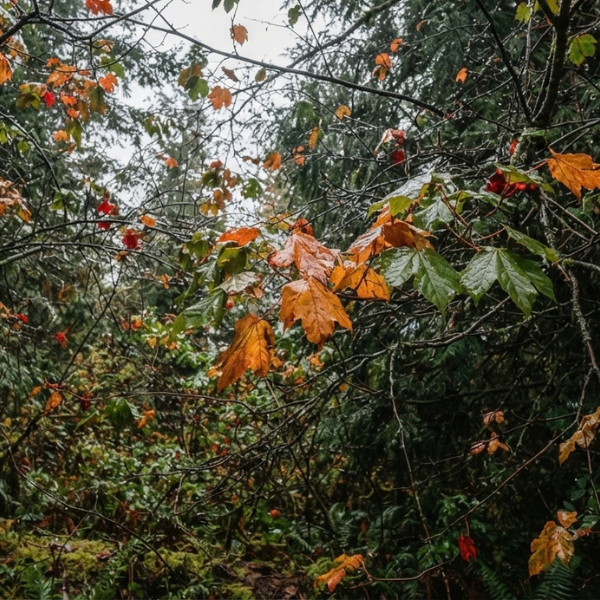
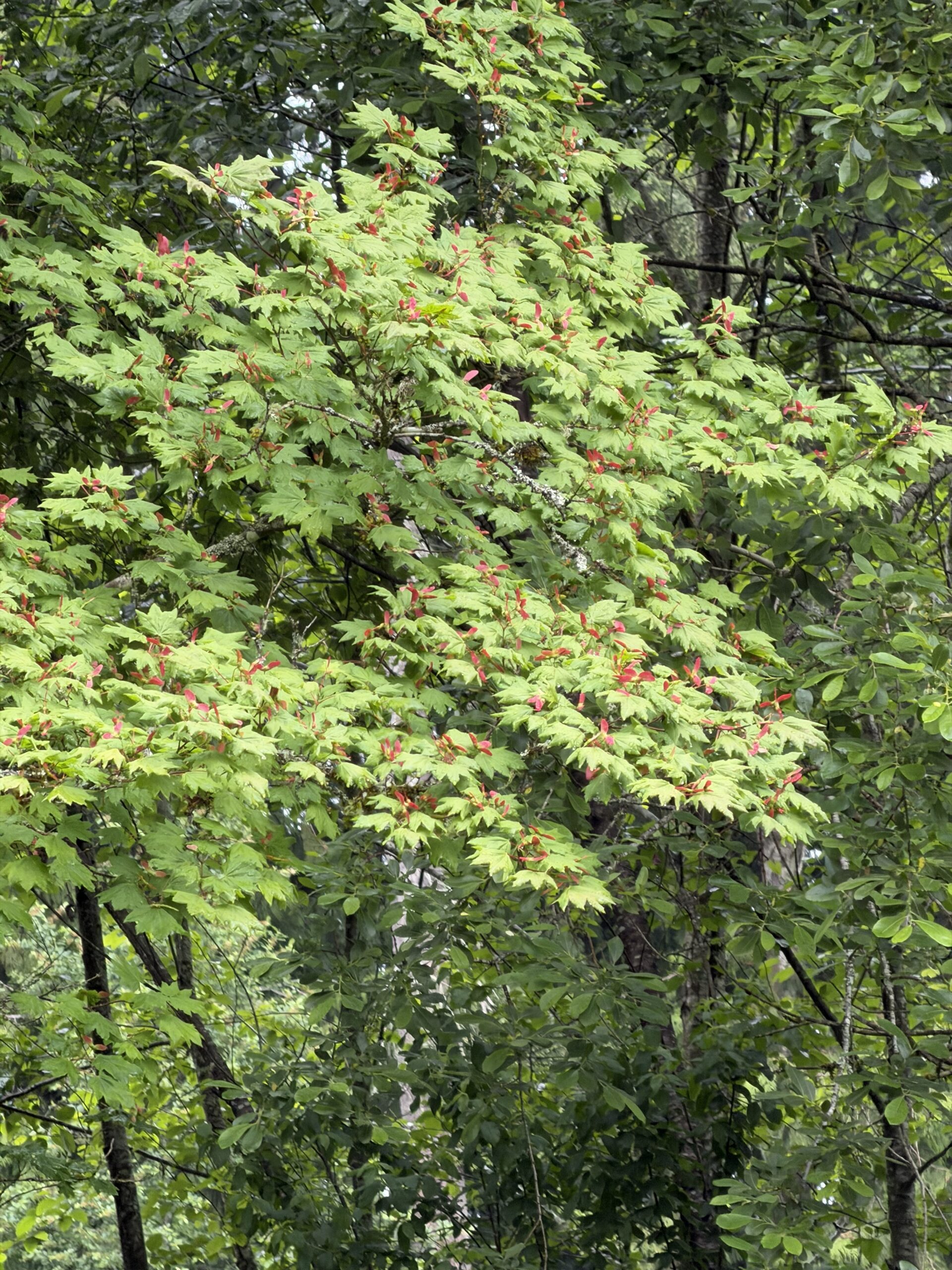
I photographed this yesterday — vine maple in late spring, canopy fully opened, chartreuse leaves punctuated by paired red samaras. From a distance, the tree reads in two simultaneous colors: cool yellow-green foliage and warm red seed pairs repeating across the canopy.
This is not decorative contrast. It is seasonal truth — the tree expressing its purpose in late May. For designers working in the Pacific Northwest, this dual-color moment offers a palette that cannot be replicated by imported stems or greenhouse-grown material.
The question is not whether the color is beautiful. The question is what that color asks of a designer.
When Native Material Refuses to Stay Static
Commercial floristry assumes a stem is fixed: ordered, shipped, predictable. A rose in December looks like a rose in July. This consistency is useful — and limiting.
Native woodland stems like vine maple do not behave this way. They are temporal. They carry time in their body.
A vine maple branch cut in early spring tells one story: soft new foliage, trembling chartreuse, winter releasing. What I photographed yesterday tells another: fully leafed, structurally confident, loaded with red samaras announcing the tree’s seasonal purpose. Come autumn, after the seeds drop, it becomes something different again — warm amber, then flame, then bare architectural branching.
Same species. Entirely different materials. Each one asking a designer to respond differently.
June-cut vine maple held fourteen days — supple, vivid, and structurally responsive.
Why Vine Maple Behaves Differently in a Designer’s Hands
Vine maple — Acer circinatum — is native to the Pacific Northwest coast and Cascade foothills. It belongs here. It evolved alongside our specific light, cold, wet springs, and dry summers. Its architecture reflects this. How woodland movement forms →
A vine maple grown in filtered understory light develops expressive forks and horizontal branching that create effortless negative space. One grown on an open slope develops a different architecture entirely. Both are vine maple. Neither is interchangeable with a species bred for greenhouse production on another continent.
Designers working with vine maple are working with a material shaped by this watershed, this soil, this light. The expressive forks are not engineered. They are the result of decades of reaching toward woodland light.
This is what imported stems cannot do.
What Imported Stems Cannot Offer Designers
Imported stems solve many design problems — color range, consistency, availability. But structurally, there are things they cannot do:
They Cannot Carry This Place
The atmospheric quality that makes a PNW woodland composition feel grounded comes from materials that grew here. Mist, moss, cold winters, wet springs — these leave a signature in the wood.
They cannot offer true seasonal narrative
When an imported stem is presented as seasonal, the seasonality is costume, not truth. Those red samaras are seasonal truth — present because the tree is doing what vine maple does in late May.
They cannot offer gesture shaped by decades
The branching habits of native shrubs and trees — the fork of cascara, the lean of dogwood, the arc of vine maple — develop over years of responding to environment. A two-year production stem cannot replicate this.
When Gesture Becomes the Designer’s Advantage
Gesture takes time. The vine maple’s expressive branching is a record of its growing — its responses to weather, shade, and the mineral composition of this hillside. That record is legible in the wood. A designer who knows how to read it is working with information no catalog can supply.
This is the structural advantage of native material: it carries its history into the composition.
The Question the Samaras Raise for Designers
Back to those samaras.
What I am genuinely curious about is which expression of vine maple a designer will find most useful:
- the late-spring branch heavy with red seed pairs — luminous, unusual, botanically specific
- or the winter architecture after the seeds drop and the branching becomes the whole story
Both feel like strong Woody Shoots’ materials. They ask to be used differently. They will appeal to different designers — or to the same designer in different project contexts.
I am going to harvest a test bundle of the samara-stage material and track it carefully: vase life, samara behavior, color shift, foliage response.
But before I do — I’m curious what you see in this material. If this arrived in your studio today, would the samaras be the draw? Or would you be thinking about the winter form?
This is the kind of conversation the small-circle model exists for.
What Vine Maple Knows About Time
Woody Shoots enters its summer pause in June. The woodland will rest. The vine maple will continue its slow turn toward autumn fire, and I will observe and let everything consolidate.
Right now, in this last window of spring, the vine maple is doing something specific and unrepeatable. It knows something about time that a production stem cannot know. Designers working with it are working with that knowledge.
For deeper ecological context, the Washington Native Plant Society documents the native woodland systems that inform the Woody Shoots palette.
Designer Resources
- Species Page: Vine Maple for Floral Designers
- Contact: Begin a conversation about seasonal availability
- How We Work: Appointment-only, small-circle model
- Spring woodland materials
Native vine maple — Acer circinatum — is available in limited seasonal expressions, each offering designers different structural and atmospheric advantages. If you’re planning work that benefits from true PNW woodland narrative, inquire about current availability and reserve material for your upcoming projects.
For further context on the ecology of this species, the Washington Native Plant Society documents the native woodland systems that inform the Woody Shoots palette.