Viburnum Harvest — A May Field Note
May 3rd, 2026 · Arlington, Washington
This spring’s Japanese Snowball Viburnum harvest at Woody Shoots was a first. The plants have been in the ground for four years. This spring, they had enough to offer a designer — and enough for Diane to cut with intention rather than observation. She walked out early, before the light changed. The clusters were heavy on the branches — heavier than expected.
She walked out early, before the light changed. The clusters were heavy on the branches — heavier than expected. Four years of root depth had produced something generous and unhurried, the kind of bloom weight that only comes from a plant that has genuinely settled into its place.
Before the First Cut
There was a moment of hesitation before the first stem came down. No doubt exactly — more like the particular care that comes before any irreversible action. Diane surveyed the plants first, following the line of each branch before cutting. Tracing it the way she once traced jumper wires before pulling or cutting in a central office — reading the system before intervening in it.
The instinct is the same. In fiber optics, you learn quickly that understanding the line before you touch it is the difference between a clean outcome and an hours-long correction. In the woodland, it turns out, the same principle applies. Follow the branch. Understand what it is doing. Then cut with intention rather than assumption.
The first two or three cuts were careful and deliberate. By the fourth or fifth, confidence had returned. The stems were coming away cleanly, the clusters intact, the branches doing exactly what four years of growth had prepared them to do.
What the Clusters Said
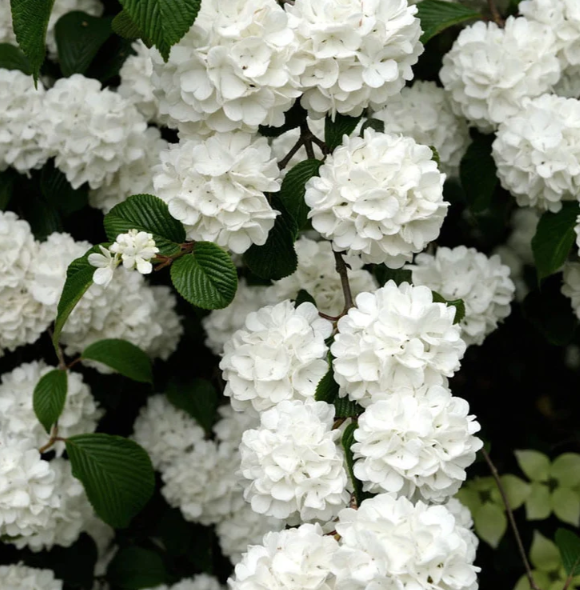
The weight was the surprise. Japanese Snowball Viburnum ‘Popcorn’ produces round, full pompon clusters — compact, generous, and distinctly their own. But reading about cluster weight and feeling it on a branch are two different things. These clusters were substantial. Dense with florets, heavy on the ascending branches, and entirely committed to the season.
That weight raised an honest question as the harvest progressed — how would a designer work with the more packed branches? Some stems carried clusters so close together that the branching architecture beneath them was barely visible. For a designer who values negative space and line — and most of the designers Woody Shoots serves do — a stem that is all bloom and no breath presents a real compositional challenge.
The answer, Diane suspects, lies in selective placement rather than wholesale use. A packed Viburnum branch does not need to carry a composition alone. Instead, it works as a generous counterpoint — billowing white against the restraint of a single Cascara arc or a few stems of osoberry. The excess of the bloom becomes the point, not the problem.
Thirteen Days Later
Today is May 16th. The stems cut on May 3rd are past peak — the clusters have begun to soften at the edges, the white deepening slightly toward cream. However, they are still usable. Thirteen days from harvest, properly conditioned and cool-stored, the stems are holding with a quiet dignity that speaks well of what the CoolBot room will make possible once it is built.
For a designer planning a wedding or installation, thirteen days of stem life changes the logistics entirely. It means a harvest can happen almost two weeks before an event. Furthermore, it means Diane can harvest at the exact right moment — when the clusters are fully open but before they begin to turn — rather than racing against a three or four-day window.
This spring’s harvest was a first. Next spring will be different — the plants will be a year more established, the harvest more confident from the first cut, and the conditioning practice refined by what this season taught. That is how a woodland atelier learns. Not from a manual, but from paying attention to what the land offers and what the season reveals.
For further context on the ecology and design behavior of this species, the Washington Native Plant Society documents the native woodland systems that inform the Woody Shoots cultivated companion palette.
Japanese Snowball Viburnum — Viburnum plicatum ‘Popcorn’ — is available from Woody Shoots each spring. For current seasonal availability, begin a conversation →
Learn more about working with this species on the Japanese Snowball Viburnum for Floral Designers page.