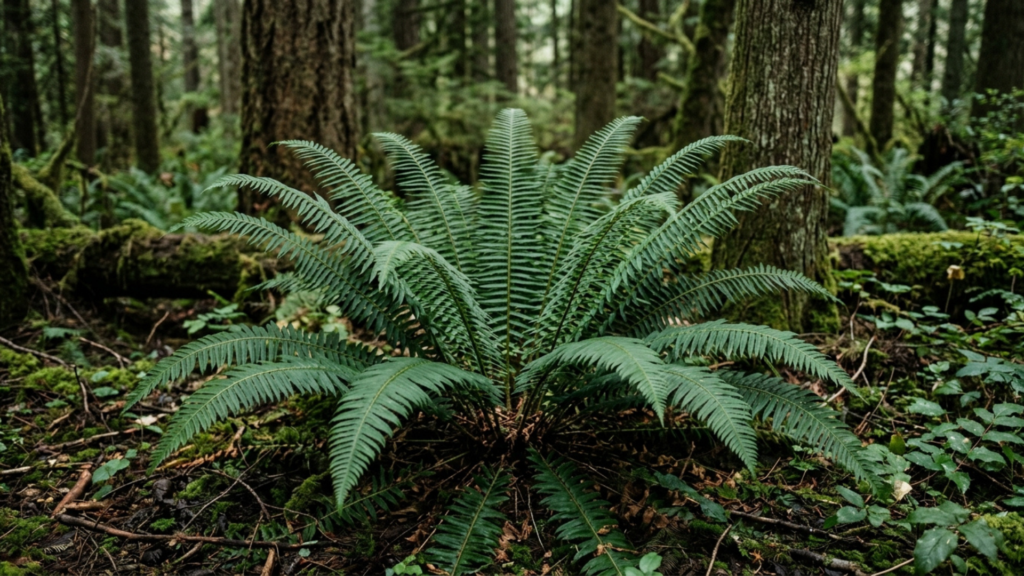
Evergreen woodland structure. Radial crowns holding quiet, architectural weight beneath the canopy.
Western Sword Fern for Floral Designers · Woody Shoots
Western sword fern (Polystichum munitum) is the Pacific Northwest’s defining evergreen understory plant. Its radial crowns create quiet, architectural structure beneath mature conifers. Designers value its matte texture, grounded posture, and reliable year‑round presence. At Woody Shoots, the fern grows in deep duff and filtered light, which produces clean fronds and strong crowns. These qualities translate directly into intentional woodland design work.
For floral designers, it brings evergreen posture, grounding texture, and a distinctly native understory character. No imported fern replicates its combination of radial architecture, matte evergreen surface, and long-season reliability in cool woodland conditions.
At Woody Shoots, Western Sword Fern develops under mature conifers in deep duff and filtered light. That habitat produces cleaner fronds, stronger crowns, and a steadier evergreen presence—qualities that translate directly into design work where structure and subtlety matter more than spectacle.
Seasonal availability
Western Sword Fern offers one of the most stable evergreen windows in the Woody Shoots calendar. Its value shifts across the year in ways that matter for composition planning.
Early Autumn — September through October
Crowns sit fully leafed from the growing season, with fronds still fresh and upright. This is a transitional window—useful for designers building compositions that bridge late-summer softness into woodland autumn structure.
Late Autumn — November
Fronds deepen in tone, and the woodland floor quiets around them. Sword fern begins to read as a more pronounced structural element—evergreen weight against bare branch and fading herbaceous material.
Winter — December through February
Peak evergreen utility. Fronds hold their posture through cold, wet conditions, providing reliable structure and grounding texture when most other woodland materials have entered dormancy.
This is the strongest window for designers seeking evergreen architecture without the visual density of conifer branches.
Early Spring — February through April
New croziers (emerging fronds) begin to push through the duff while mature fronds still hold. This dual presence—fresh emergence beneath established structure—creates a nuanced woodland character, particularly effective in compositions that want to carry winter’s gravity into spring’s first movement.
Late Spring — April through May
New fronds extend and unfurl, gradually replacing the oldest foliage. Best used for lush woodland work where fresh evergreen texture and radial form carry the composition rather than strict winter architecture.
For current availability within these windows, visit the Seasonal Botanicals page or inquire directly.
Design behavior
Western Sword Fern carries a grounded, radial architecture that makes it one of the most structurally decisive materials in the woodland palette.
Its gesture is composed rather than expressive—fronds rise from the crown in a clear, organized arc, defining a basin of space rather than reaching outward unpredictably. The material reads as medium-to-heavy in visual weight: substantial enough to anchor a composition, quiet enough to support more airy elements without overwhelming them.
In vessel work, sword fern creates a stable evergreen base that allows branch-led materials, flowering woodland stems, and ephemeral textures to move above it with clarity. In installations, its radial crowns can be used to define low woodland planes, ground vertical structures, or soften the transition between hardscape and taller botanical elements.
Western Sword Fern is particularly effective in winter and early-spring compositions where evergreen presence must feel intentional rather than decorative, woodland installations needing a stable understory layer, and editorial work where the fern’s radial geometry and matte texture are part of the visual narrative rather than background filler.
For further context on how evergreen structure functions in woodland compositions, see Evergreen Structure: A Designer’s Guide and the Woodland Behavior Glossary.
Conditioning and handling
Western Sword Fern conditions reliably and holds well with straightforward handling.
Harvest fronds from mature crowns, cutting cleanly at the base of the stipe (stem) and placing immediately into cool water. A fresh angled recut before design work improves uptake and longevity.
Strip lower pinnae (leaflets) where they will sit below the water line to keep buckets clear and reduce bacterial buildup. In studio conditions, fronds hold their evergreen color and structure well—tips remain clean, and the matte surface does not gloss excessively under light.
For vessel work, expect seven to ten days of strong performance with proper conditioning; in cooler environments and larger, more mature fronds, vase life can extend beyond that window. In installation work, sword fern performs excellently in chicken wire and other mechanical structures, its fronds flexible enough to place yet firm enough to hold their posture once set.
Avoid over-stripping the crown in the field—selective cutting preserves plant health and ensures consistent future harvests.
Ecology and provenance
Western Sword Fern is native to western Washington, where it forms dense understory colonies beneath Douglas-fir, western red cedar, and other conifers.
The Polystichum munitum at Woody Shoots is part of a long-established woodland community on the Arlington property, reflecting true native provenance rather than ornamental fern behavior—a distinction that matters for its design character.
Because sword fern develops in cool, shaded, moisture-stable conditions, it produces:
- Strong, symmetrical crowns with clear radial architecture
- Matte evergreen fronds that read as quiet structure rather than glossy ornament
- Reliable year-round presence that responds well to stewardship and selective cutting
Its evergreen persistence reflects actual woodland conditions rather than greenhouse forcing—a quality designers working in atmospheric and editorial spaces notice immediately when they want compositions to feel genuinely tied to the Pacific Northwest understory.
The Washington Native Plant Society documents the full ecology and native range of Polystichum munitum for designers who want deeper botanical context behind this species.
Color and texture notes
The tonal character of Western Sword Fern is more stable than that of many seasonal materials. Still, it shifts subtly throughout the year in ways that reward close attention.
In early autumn, the fronds appear fresh mid-green, with a quiet matte surface. This quality helps bridge late-summer palettes into woodland structure.
Through winter, the color deepens into a cooler evergreen. The fern’s architectural role also becomes more pronounced. Its texture feels firm, grounded, and visually substantial without becoming harsh.
Early spring introduces tension between mature fronds and emerging croziers. New growth brings brighter green and softer texture against the established evergreen architecture.
By late spring, the palette returns to a more uniform, fresh green. New fronds gradually replace the oldest foliage.
Texture throughout the arc is defined by:
- Matte surface with fine, repeating leaflet rhythm
- Strong midrib and clean tips that photograph with quiet clarity
- Radial crown structure that creates a natural basin or fan in composition
This combination makes sword fern particularly effective in both intimate woodland arrangements and larger-scale installations where evergreen texture must read as intentional structure rather than background noise.
Pairing notes
Western Sword Fern pairs most naturally with materials that either echo its woodland provenance or contrast its grounded posture.
Western Red Cedar tips provide a soft, cascading counterpoint—fine evergreen texture against sword fern’s more architectural fronds, one of the most effective winter pairings in the Woody Shoots palette. Vine Maple offers expressive, wandering branch movement above the fern’s stable base, creating a layered woodland narrative.
Snowberry branching introduces pale punctuation and light structural rhythm, lifting the composition without disturbing the fern’s grounding role. Osoberry and other early-spring flowering woodland stems bridge the transition from winter evergreen structure into ephemeral spring movement, sitting comfortably above sword fern’s radial crowns.
For full species documentation on these and other pairing materials, visit the Woodland Species Atlas and Species Index.
Notes from the understory
In the quiet months, the crowns hold. Fronds rise from the duff with a kind of steady resolve—evergreen architecture that does not ask for attention but keeps the woodland intact.
Cut in winter, Western Sword Fern carries that same grounded presence into the studio. Designers reach for it when they want the arrangement to feel anchored—when the composition needs a base that feels like it belongs to the forest rather than the vase.
For a closer look at how spring crown reclamation shapes autumn material, read Western Sword Fern: The Evergreen That Rebuilds Itself.
Working with Woody Shoots
Western Sword Fern is harvested in small, selective batches from the Arlington woodland throughout the year. Harvest quantities depend on crown maturity, seasonal growth, and long-term understory stewardship.
Diane manages the fern populations through careful debris removal and conservative cutting, rather than aggressive thinning. Availability therefore reflects both the season and the health of each crown.
Contacting Woody Shoots one to two weeks before an installation or event allows the greatest flexibility. This lead time helps align harvesting with your project’s needs.
Designers planning winter or early-spring woodland work are encouraged to inquire early. This is especially helpful when evergreen structure and grounded texture are central to the composition.
Western Sword Fern is among the most quietly indispensable materials in the Woody Shoots woodland calendar.