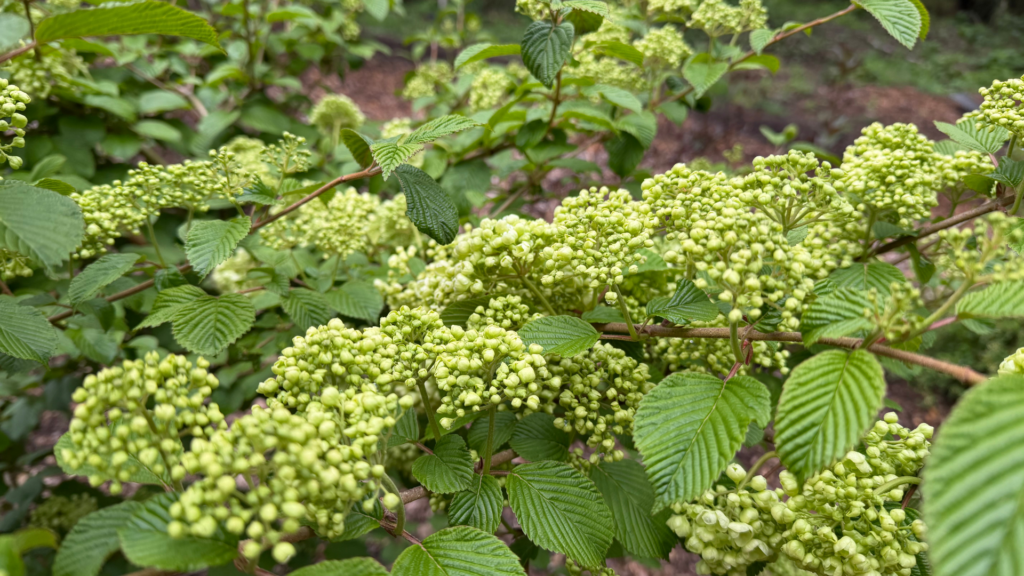
White billow. The most architecturally generous bloom in the spring woodland palette.
Japanese Snowball Viburnum for Floral Designers
Japanese Snowball Viburnum for floral designers offers one of spring’s most distinctive bloom structures — round, pompon-style bloom clusters on strongly horizontal branching that reads as architectural rather than ornamental. Known botanically as Viburnum plicatum ‘Popcorn,’ this variety was selected specifically for its early bloom timing, compact cluster form, and design compatibility with the native woodland palette at Woody Shoots. The plants reach their fourth year of establishment on the Dixon family land in Arlington, Washington, this autumn. That maturity milestone signals the beginning of reliable, character-rich seasonal harvests for years to come.
Seasonal Availability
Japanese Snowball Viburnum offers a focused and generous spring bloom window — one of the most anticipated design moments in the Woody Shoots seasonal calendar.
Mid Spring — April through May. The primary bloom window. Clusters emerge as soft green popcorn-like buds, then open to pure white rounded pompon clusters along strongly ascending branches. Because ‘Popcorn’ blooms earlier than most Viburnum plicatum varieties, it aligns naturally with the late-season osoberry and red flowering currant windows — creating a spring palette moment no other source provides.
Late Spring — May. Peak bloom extends well into May in the cool PNW understory. Stems harvested at the right stage — clusters fully open but not yet browning — hold exceptionally well with cool storage. Furthermore, with proper conditioning and cool room storage, stems perform for nine to ten days from harvest. That longevity makes Japanese Snowball Viburnum one of the most reliable spring materials for designers planning weddings and events several days in advance.
Summer through Winter. After bloom, Japanese Snowball Viburnum offers foliage on clean, horizontal branching through summer. In autumn, foliage shifts to burgundy and deep red tones. Moreover, bare winter branching reveals the plant’s most architectural moment — a clean, strongly ascending structure that reads as a companion to the winter native palette.
For current availability within these windows, visit the Seasonal Botanicals page or inquire directly.
Japanese Snowball Viburnum in Design — Behavior and Character
Japanese Snowball Viburnum for floral designers carries a strongly horizontal, ascending branching structure with round, full pompon bloom clusters that make it one of the most architecturally expressive cultivated companions in the Woody Shoots spring palette. Its gesture is generous and layered — clusters billow along the branches with a natural horizontal rhythm that creates depth and movement simultaneously. As a result, a single well-chosen branch can carry an entire composition.
In terms of visual weight, Japanese Snowball Viburnum reads as medium to substantial — generous enough to anchor a spring composition structurally, refined enough to avoid competing with more delicate native materials around it. The pure white pompon clusters photograph with exceptional clarity in both natural and studio light — a quality that makes this material particularly effective for editorial and bridal work where bloom clarity defines the image.
Japanese Snowball Viburnum for floral designers is particularly effective for spring wedding work, where architectural bloom structure carries the design. It suits large-scale installation work where horizontal branching creates spatial narrative and depth. Additionally, it works exceptionally well in editorial compositions where the branch itself — bloom clusters and all — is the subject, and in spring palettes where a cultivated white bloom provides contrast against native green and emerging foliage. For further context on how architectural branching functions in woodland compositions, see Evergreen Structure: A Designer’s Guide and Movement: A Designer’s Guide.
Conditioning and Handling
Japanese Snowball Viburnum conditions reliably with handling appropriate to its bloom character. Begin with a warm water start — recut stems at a fresh angle and hydrate for four to six hours before use. Because the bloom clusters are the primary design element, avoid submerging them during conditioning. Keep clusters above the waterline to prevent premature browning of the florets.
In the studio, Japanese Snowball Viburnum holds best when kept cool and away from direct heat. Cool room storage at Woody Shoots — maintained by a dedicated CoolBot system — allows stems to hold at optimal temperature from harvest through pickup. As a result, designers receive stems already cold-conditioned and ready for immediate use or continued cool storage before an event.
With proper cool room conditioning from harvest, expect a stem life of nine to ten days. This makes Japanese Snowball Viburnum one of the most event-reliable spring materials in the Woody Shoots palette — designers can plan pickups three to four days before a wedding or event with full confidence in stem performance.
For installation work, Japanese Snowball Viburnum performs best in water sources. Chicken wire and hand-tied structures both support its natural horizontal branching well. Because the horizontal branching structure is the material’s primary design asset, work with the natural gesture rather than forcing stems into vertical positions.
What thirteen days of stem life revealed →
Ecology and Provenance
Japanese Snowball Viburnum is native to Japan and China — a cultivated ornamental rather than a PNW native species. At Woody Shoots, it is grown as a deliberate, cultivated companion — selected for its design compatibility with the native woodland palette, its early bloom timing, and its architectural branching character.
Because the ‘Popcorn’ variety grows on the Dixon family land in Arlington under the same cool, moist PNW conditions as the native species alongside it, its bloom character and stem quality reflect genuine establishment in this specific place. Furthermore, plants four years in the ground develop a root depth and seasonal resilience that nursery-grown material cannot replicate — the difference is visible in stem strength, cluster density, and branch posture.
One note for ecologically-minded designers — Viburnum plicatum is listed as potentially invasive in some parts of the United States. In the Pacific Northwest, however, it does not appear on Washington State’s invasive species list and grows here as a well-behaved cultivated ornamental. Woody Shoots monitors its growth carefully as part of the overall stewardship practice on the Arlington land.
The Washington State Noxious Weed Control Board maintains the current invasive and noxious weed list for Washington State for designers who want to verify the ecological status of cultivated companions in their sourcing practice.
Color and Texture Notes
Japanese Snowball Viburnum’s color arc across its seasonal window moves through three genuinely distinct tonal moments — each serving different compositional needs.
Spring brings the most dramatic moment — pure white pompon clusters on clean, strongly ascending branches. Clusters emerge as soft green buds before opening to white, creating a brief transitional window with both green and white present simultaneously. That transitional stage is particularly useful for designers seeking a more restrained, less full-blown bloom character. Summer deepens the palette to rich green foliage on clean horizontal branching. In contrast, autumn shifts foliage to burgundy and deep red — a warm tonal presence that complements the native autumn palette without competing with it.
Texture throughout the bloom window is distinctive — round, full pompon clusters with a soft, almost billowing surface that reads as generous without heaviness. Consequently, Japanese Snowball Viburnum adds volume and tonal brightness to a composition without the visual density of solid-headed blooms.
Pairing Notes
Japanese Snowball Viburnum pairs most naturally with native spring materials that share its seasonal moment or provide complementary contrast to its white bloom clusters. Vine Maple spring emergence is the most natural companion — chartreuse new growth alongside white pompon bloom creates a composition entirely rooted in the PNW spring woodland. Additionally, Osoberry’s soft arcing line complements Viburnum’s more structured horizontal branching — movement and architecture in a single pull. Red Flowering Currant provides warm color contrast against white bloom clusters — a combination that reads as a vivid spring celebration without imported materials. Furthermore, Western Red Cedar tips provide the most grounding evergreen presence beneath the bloom — soft cascading texture that anchors without competing.
For full species documentation on these and other pairing materials, visit the Woodland Species Atlas and Species Index.
Notes From the Understory
Japanese Snowball Viburnum arrives in May like a quiet announcement — clusters of white billow along the branches before anything else has caught up with the season. Designers reach for it when they want the arrangement to feel generous without being showy, when white needs to carry architectural weight rather than softness, and when the branch itself — horizontal, ascending, unhurried — says more than any bloom placement could.
What thirteen days of stem life revealed →
Working With Woody Shoots
Diane grows Japanese Snowball Viburnum for floral designers as a cultivated companion in the Arlington woodland. The spring bloom window runs from April through May. Because the ‘Popcorn’ variety blooms earlier than most Viburnum plicatum varieties, it aligns naturally with the late native spring palette — creating a design window that rewards early outreach and careful timing.
CoolBot cold room storage at Woody Shoots allows stems to be harvested at peak bloom stage and held at optimal temperature through pickup. As a result, designers have more flexibility in planning pickup timing relative to their event dates. Reaching out two to three weeks ahead of a spring event gives Diane the best opportunity to align the harvest with the designer’s dates and bloom stage preferences.
For large-scale spring installations and weddings, Diane offers scouting consultations and scaled pulls designed around the vision rather than a standing inventory. Designers working at installation scale benefit most from early outreach — six to eight weeks in advance gives the most room to plan bloom timing across the full spring palette.
Designers new to Japanese Snowball Viburnum are welcome to reach out with questions. Diane will share what the current bloom stage looks like and whether the timing aligns with a specific project window.