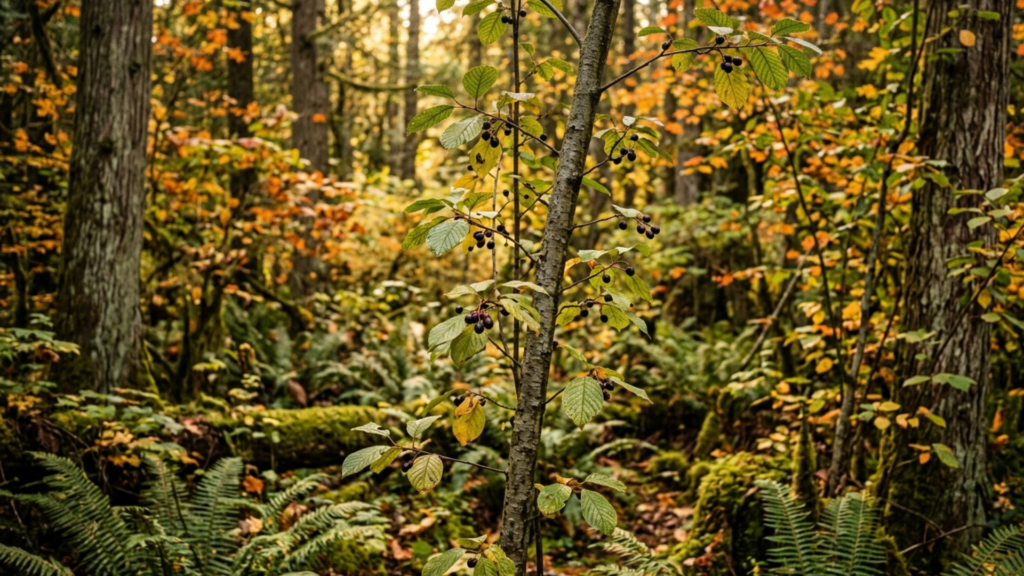
Quiet architecture. The woodland’s most patient line — bright in spring, bare and honest in winter.
Cascara Branches for Floral Designers
Cascara branches for floral designers offer a clean, upright line with expressive branching and deeply veined foliage. Known botanically as Frangula purshiana and sometimes listed as Rhamnus purshiana, Cascara is one of the Pacific Northwest woodland’s most architecturally distinctive native trees. Its seasonal arc moves from spring’s bright emergence through autumn’s warm color into winter’s sculptural bare branch. Because Cascara grows slowly in cool, shaded understory conditions, its branches develop a refined, deliberate character. No cultivated material replicates that quality.
Seasonal Availability
Cascara offers one of the most varied seasonal palettes in the Woody Shoots calendar. Each window offers a genuinely different material character. Moreover, designers who understand the arc access a species that works across multiple seasons rather than just one.
Spring — March through May. The most expressive opening window. Fresh bright green foliage emerges on clean, upright branching — luminous, architectural, and entirely distinctive. Spring Cascara reads as awakening and structural lift simultaneously. As a result, this is the window designers return for season after season.
Summer — June through August. Foliage deepens to a rich, glossy dark green on clean branches. However, Woody Shoots closes in July and August — Cascara summer material is not available. The summer pause allows the plants to recover and prepare for autumn.
Autumn — September through November. Foliage shifts from dark green through yellow to warm orange as the season cools. This transitional palette is among the most distinctive in the Woody Shoots autumn calendar — warm, textural, and deeply atmospheric. In turn, Cascara autumn branching reopens the season with color and gestural depth.
Winter — December through February.Leaves drop to reveal the species’ most architectural moment — clean, expressive bare branching with smooth gray bark and distinctive node rhythm. Winter Cascara is a structural designer’s material. It holds line and defines space. Furthermore, evergreen materials alone cannot provide that compositional architecture.
For current availability within these windows, visit the Seasonal Botanicals page or inquire directly.
Cascara Branches in Design — Behavior and Character
Cascara branches carry a tall, refined, upright line with soft branching. As a result, it is one of the most architecturally intelligent materials in the Woody Shoots palette. Its gesture is quiet and deliberate. Instead of reaching dramatically or wandering expressively, Cascara holds a natural, woodland-true posture that gives compositions genuine structural presence.
In terms of visual weight, Cascara reads as medium — substantial enough to anchor a composition structurally, yet refined enough to function as a gesture rather than mass. The deeply veined foliage creates a distinctive textural surface. It reads as wavy, crinkled, and entirely native — very different from smooth cultivated leaves. Additionally, bare winter branching carries a graphic node rhythm that gives each stem its own quiet punctuation.
Cascara branches for floral designers are particularly effective for spring compositions needing architectural lift and luminous green. They suit autumn palettes seeking warm native foliage, winter installations requiring clean structural line, and editorial work where the branch itself is the subject. For further context on how line and structure function in woodland compositions, see Evergreen Structure: A Designer’s Guide and Movement: A Designer’s Guide.
Conditioning and Handling
Cascara conditions reliably across all seasonal windows with handling appropriate to each stage. For spring and autumn foliage material, recut stems at a fresh angle and place immediately in deep, cool water. Because the foliage is large and transpires readily, deep conditioning of four to six hours significantly extends performance. This applies to both studio and installation environments.
For winter bare branching, Cascara requires minimal conditioning — recut stems and place in water to prevent drying. Bare branches hold exceptionally well without water in installation contexts. As a result, they are among the most versatile structural materials in the winter palette.
In the studio, Cascara foliage holds well when kept cool and away from direct heat. Strip lower leaves to prevent bacterial buildup and keep water clean. The deeply veined leaf surface can mark if compressed. Therefore, store loosely and handle with care to preserve the texture that gives this species its design value.
Foliage material performs well for seven to ten days with proper conditioning. Bare winter branching lasts indefinitely in dry installation contexts and ten to fourteen days in water.
Ecology and Provenance
Cascara is native to western Washington. It grows in shaded forests, mixed woodlands, and moist ravines across Snohomish County and the broader Pacific Northwest. At Woody Shoots, Cascara grows wild on the Dixon family land in Arlington. The land has been in the Dixon family and pesticide-free since 1982. That history reflects true local provenance shaped by decades of natural woodland ecology.
Because PNW-grown Frangula purshiana develops slowly in cool, shaded conditions, it produces a refined, deliberate branching character. That quality distinguishes it from faster-grown nursery material. Furthermore, the foliage develops a deeper vein structure in genuine woodland conditions. The richer surface texture is something designers notice immediately.
The Washington Native Plant Society documents the full ecology and native range of Frangula purshiana for designers who want a deeper botanical context behind this species.
Color and Texture Notes
Cascara’s color arc is one of the most complete of any species in the Woody Shoots palette. It moves through four genuinely distinct tonal moments. Each serves different compositional needs.
Spring brings bright, luminous green with a fresh, almost chartreuse quality as new foliage emerges — clean and architectural against still-bare understory. Summer deepens that green to a rich, glossy dark tone with the wavy, crinkled leaf surface at its most pronounced. In contrast, autumn moves through yellow into warm orange — a native fall palette that no imported foliage material replicates authentically. Winter strips the palette entirely to smooth gray bark and expressive node rhythm — graphic, structural, and entirely its own.
Texture throughout the foliage arc is distinctively wavy and crinkled. Deeply veined leaves catch light differently from smooth cultivated foliage. Consequently, they read as genuinely native in both studio and natural light.
Pairing Notes
Cascara pairs naturally with materials that complement its structure or provide seasonal contrast. Western Red Cedar tips are the most grounding winter companion. Soft cascading evergreen texture against Cascara’s bare line creates a composition rooted in the PNW woodland. Additionally, Red Osier Dogwood provides saturated winter color contrast alongside Cascara’s gray branching. In spring, Red Flowering Currant and Osoberry share Cascara’s seasonal moment. Together they create compositions that feel entirely of this place and time. In autumn, Snowberry’s pale berry punctuation against Cascara’s warm foliage is one of the most distinctive seasonal combinations in the palette.
For full species documentation on these and other pairing materials, visit the Woodland Species Atlas and Species Index.
Notes From the Understory
Cascara holds its line across every season — bright in spring, deep in summer, warm in autumn, bare and honest in winter. It is the woodland’s quiet backbone, the material that asks nothing dramatic of the designer but gives everything the composition needs to stand. Designers reach for cascara branches when they want the work to feel rooted — in place, in season, and in the unhurried intelligence of a woodland that knows what it is doing.
Working With Woody Shoots
Cascara branches for floral designers are harvested in small batches from the Arlington woodland throughout the September through June season. Spring and autumn represent the most expressive design windows. Because Cascara grows slowly and is harvested selectively, quantities vary with the season. The plant’s recovery rhythm shapes what is available. Reaching out one to two weeks ahead gives Diane the best opportunity to align the harvest with the designer’s dates.
For large-scale installations and events, Diane offers scouting consultations and scaled pulls designed around the vision rather than a standing inventory. Designers working at installation scale are encouraged to reach out four to six weeks in advance — Cascara’s slow growth cycle means early planning produces the strongest harvest alignment.
Designers planning spring installations or autumn events are encouraged to reach out early. Cascara at peak spring emergence and full autumn color are among the most sought-after windows in the Woody Shoots calendar.
Designers new to Cascara are welcome to reach out with questions — Diane will share what the current season has to offer and whether the timing aligns with a specific project.