Woodland Grounding: A Designer’s Guide
Woodland grounding is the forest’s quiet stabilizing force — the way low, steady forms create weight, tone, and calm at the base of a composition. For floral designers, understanding grounding reveals how materials anchor emotion, balance expressive stems, and give arrangements their sense of place. Without grounding, movement floats. Without grounding, atmosphere dissipates. Grounding is the quality that makes everything else in a composition feel intentional rather than accidental.
What Grounding Is
Grounding is the visual and structural weight that settles a composition. It is not simply the placement of low materials at the base of an arrangement. Instead, grounding is a quality of presence — the way certain species carry tonal depth, quiet mass, and spatial steadiness that anchors everything around them.
Because grounding materials tend to grow slowly in cool, shaded conditions, they develop a density and deliberateness that faster-growing species lack. As a result, they bring a sense of permanence and place into compositions that no imported filler material can replicate. Furthermore, they connect the arrangement back to the woodland floor — to the moss, the duff, the layered understory — in a way that gives the finished work genuine ecological character.
How Grounding Forms in the Woodland
Grounding develops through three overlapping forces — each leaving its signature on the species’ final form and behavioral character.
Forest Floor Structure. Moss, duff, and decaying wood create a soft, stable base that visually anchors the understory. Species that grow within this layer develop spreading, low forms shaped by the forest floor’s consistent moisture and filtered light. In turn, these forms carry that quality of settled presence directly into design work.
Evergreen Shrubs and Ferns. Low, dense evergreen forms provide consistent tone and structure across the active seasons. Rather than retreating in winter, these species maintain their grounding presence year-round — offering the compositional steadiness that deciduous materials cannot sustain through the cold season. The Evergreen Structure: A Designer’s Guide explores how evergreen mass relates to grounding in depth.
Moisture and Shade. Cool, shaded conditions encourage species with spreading, layered forms that naturally ground the forest visually. Because these conditions slow growth and concentrate form, shade-grown grounding species develop a quiet density that translates directly into compositional weight. The Understory Light: A Designer’s Guide explores how light and shade shape this process across the full palette.
The Designer’s Lens — Reading Grounding
Grounding species carry quiet cues about stability and place. Designers who learn to read these cues gain access to a level of material intelligence that transforms how they build compositions from the ground up.
Mass is the first quality to read. Where a species has developed density — spreading foliage, layered branching, accumulated volume close to the ground — it offers the visual weight that settles a composition and gives lighter materials something to read against. Tonal depth is the second quality. Deep greens, blue-greens, and the rich burgundy tones of cold-season foliage set the emotional temperature of a composition in a way that bright or pale materials cannot. Repetition is the third. Where grounding species repeat across a composition — the same foliage form appearing at intervals — they establish a rhythm that creates cohesion without monotony.
Together these three qualities — mass, tonal depth, and repetition — make grounding species the compositional foundation of woodland design. Moreover, understanding them transforms the forest floor from a background detail into an active design resource.
Applying Woodland Grounding in Design
Grounding works best when treated as the first layer rather than the last. Rather than adding grounding materials to fill gaps at the end, designers who understand woodland grounding place it first — establishing the tonal anchor and visual weight that all expressive materials will read against.
Strong grounding steadies compositions that include significant movement. In turn, movement materials rely on grounding to prevent them from reading as unresolved or floating. The Movement: A Designer’s Guide explores this relationship in detail. Similarly, evergreen structure and grounding work together to create the woodland’s full spatial language — structure provides the vertical architecture while grounding provides the horizontal weight beneath it.
Allowing grounding materials to extend beyond the vessel edge — spilling slightly, spreading quietly — mirrors how forest floor species actually grow. As a result, compositions built with genuine grounding feel rooted rather than arranged. Negative space within the grounding layer is equally important. Just as the forest floor has open patches between moss colonies and fern fronds, a composition’s grounding layer benefits from breathing room rather than dense coverage.
Architecture for floral depth →
Species That Express Woodland Grounding Well
Some species carry woodland grounding more clearly than others.
The following materials from the Woody Shoots palette are particularly useful for designers learning to read and work with grounding presence:
- Salal — broad leathery foliage with strong horizontal branching and deep green tonal weight
- Evergreen Huckleberry — fine-textured branching with persistent small-leaf foliage and quiet density
- Oregon Grape — architectural compound foliage with strong winter color and structural grounding presence
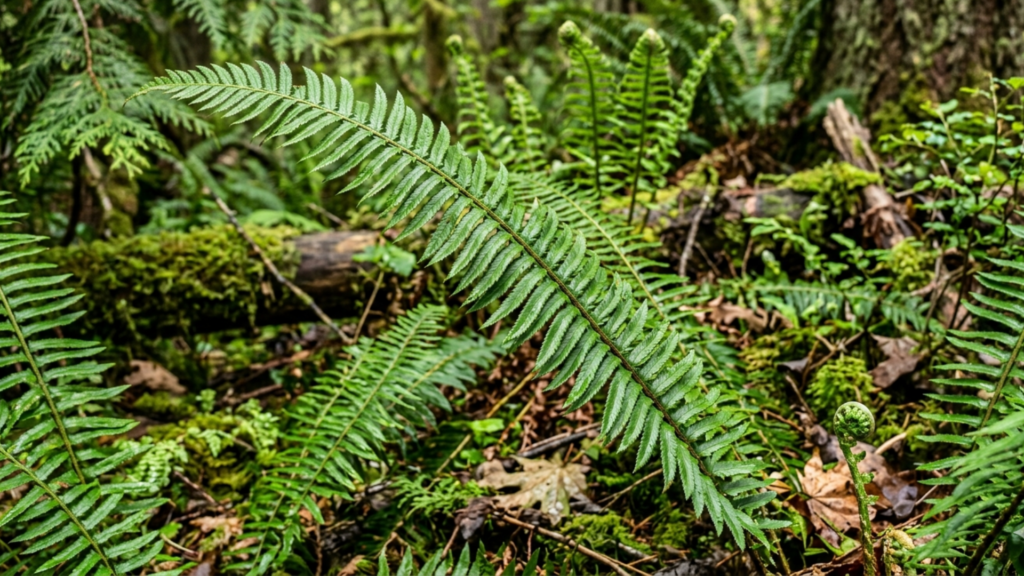
- Western Sword Fern — bold, arching fronds with deep green tone and strong visual mass
- Deer Fern — finer-textured fronds with a quieter, more atmospheric grounding presence
- Mosses — surface texture and tonal softness that connects compositions directly to the forest floor
- Red Huckleberry — fine branching with delicate seasonal foliage and subtle grounding character
- Vine Maple — low juvenile forms offer spreading, multi-stemmed grounding in shaded understory conditions
For full species behavior documentation, visit the Woodland Species Atlas and Seasonal Botanicals.
The Species Index organizes the full palette by behavioral group.
Woodland grounding is the forest’s stabilizing presence — a record of how plants create weight, tone, and calm within a shifting environment. When designers understand grounding, they begin to see how stability shapes emotion, balance, and atmosphere in their work. The ground is not where a composition ends. Instead, it is where the composition finds its reason to stand.
Continue to the Materials Guide to explore how grounding species function within the full Woody Shoots palette.
For further reading on the stabilizing role of forest floor species, see The Silent Helpers of the Forest — American Forest Management.