Understory Light: A Designer’s Guide
Understory light is the quiet architect of the woodland. It shapes how plants reach, lean, settle, and hold themselves in space. For floral designers, understanding this light is essential — it reveals why woodland materials behave as they do and how their gestures carry the intelligence of the forest into composition.
What understory light is
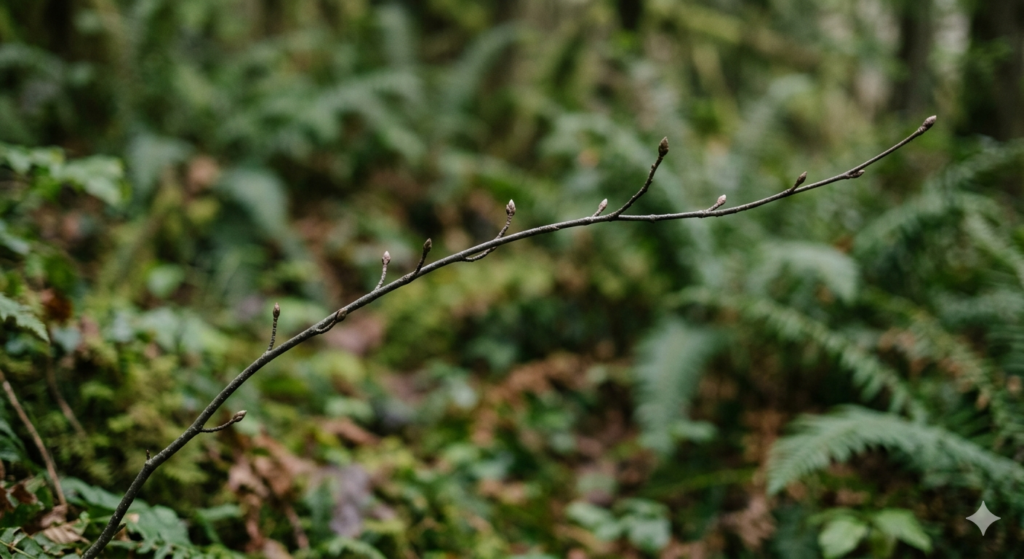
Understory light is not shade. Instead, it is a filtered, fractured, softened illumination created by the layered interaction of evergreen canopy, seasonal leaf cover, branching structure, moisture in the air, and the forest’s vertical depth. Because these elements shift with season, weather, and time of day, the light beneath the canopy is never static. It creates subtle gradients rather than hard contrasts — and that quality is precisely why woodland materials feel calm, atmospheric, and quietly expressive in design.
How Light Shapes Plant Behavior
Understanding understory light means understanding why stems move the way they do. Each of the four primary behavioral qualities described in the Woodland Behavior Glossary has its roots in the way plants respond to this light.
Line forms as stems reach toward the strongest available light — creating long, elegant vectors, slight arcs, and quiet directional asymmetry shaped by the canopy above.
Movement develops because light shifts through the day and across seasons. As a result, plants bend around obstacles, lean toward openings, and curve toward fractured beams in ways that give each stem its individual gestural character.
Grounding emerges in low-light conditions, where plants respond by developing broader leaves, denser basal growth, and slower, sturdier forms that anchor rather than reach.
Atmosphere is the cumulative effect of understory illumination on surface and shadow — softened edges, matte finishes, cool undertones, and the quiet tonal depth that makes woodland materials feel rooted in a specific place.
The Designer’s Lens — Reading Light in Materials
When a designer picks up a woodland stem, they are holding a record of its light environment. Every curve, arc, and taper tells a story. A stem’s reach marks the direction of strongest light. Its curve signals an obstacle or a shift in illumination. Where it thickens shows a grounding response to low light. A thinning stretch reveals its effort to move toward opportunity. Where it softens, atmospheric influence shaped its surface.
This is why woodland materials behave differently from cultivated stems — they were not grown toward uniform light. Furthermore, their gestures are not manufactured. They are earned, slowly, through seasons of reaching, bending, and settling in filtered forest shade.
Applying Understory Light Principles in Design
Understanding how understory light works changes how a designer builds a composition. Rather than placing materials symmetrically, designers who understand this light work with gradients — moving from density toward openness the way a woodland canopy transitions to understory. Instead of forcing contrast, they allow directional line to guide the eye naturally through the arrangement. They layer materials the way the forest layers itself — canopy to understory to groundplane — and they let asymmetry stand rather than correcting it toward balance.
Most importantly, they let atmosphere breathe. Negative space in a woodland composition is not emptiness. Rather, it is the equivalent of the light between branches — present, intentional, and doing quiet structural work.
Species That Reveal Understory Light Well
Some species carry the effects of understory light more visibly than others. The following materials from the Woody Shoots palette are particularly useful for designers learning to read and work with this quality:
- Vine Maple — arching, multi-directional branching shaped by filtered canopy light
- Cascara — asymmetrical gestural line developed through lateral light reach
- Osoberry — airy early-season branching with delicate directional movement
- Young Cedar Growth — soft layered drape shaped by deep shade and moisture
- Red Osier Dogwood — strong upright line with seasonal color intensified by cold and low light
For full species behavior documentation, visit the Woodland Species Atlas and Seasonal Botanicals.
Understory light is the quiet force that shapes the woodland’s gestures. When designers understand it, they begin to see why stems move the way they do, why certain materials feel calm, and why woodland compositions breathe differently from arrangements built with cultivated stems.
Continue to Movement: A Designer’s Guide to explore how understory light translates into compositional gesture.
For the regional ecological context, see the Washington Natural Heritage Program.