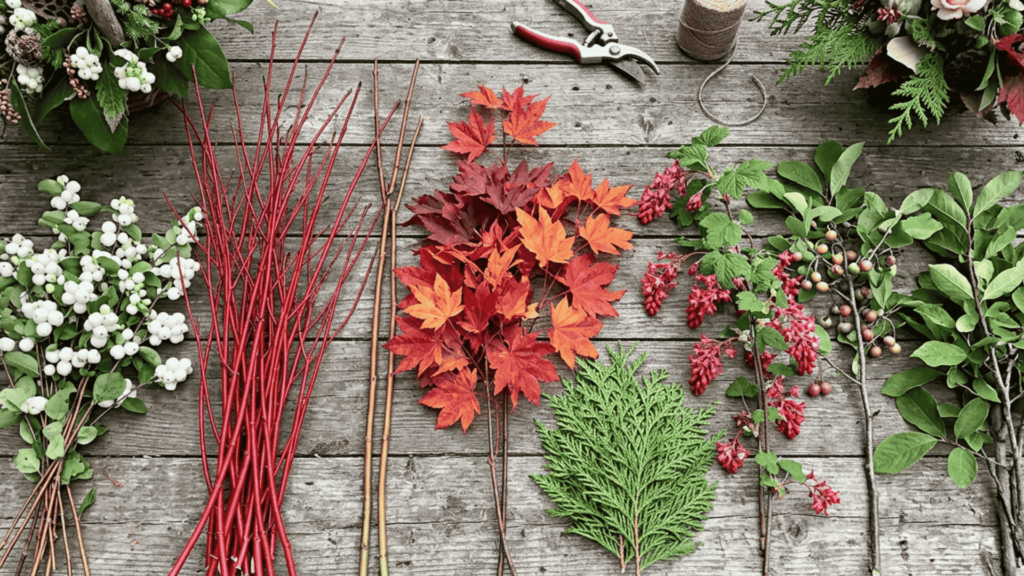
Woodland Materials guide
This Woodland Materials Guide explores stems shaped by understory light, slow growth, and weather. They carry the architecture of where they grew—crooked reaches toward sunbreaks, tight bud clusters, lichen‑softened bark, and the quiet tension of plants that survive by restraint rather than abundance. Designers use these materials not to fill space, but to draw in it. They create gesture, depth, and narrative. They hold the emotional temperature of a season more honestly than any bloom.
This guide maps the material character of the Woody Shoots palette — how stems behave, what weather writes into them, and how to read their qualities before placing them in a composition. For individual species documentation, visit the Woodland Species Atlas and Species Index.
Why Designers Reach for Woodland Materials
Woodland stems offer qualities that cultivated materials cannot replicate. Gesture comes first — long, irregular lines that guide the eye through a composition without forcing it. Structure follows — stems that hold shape without wire, that stand on their own conviction rather than mechanical support. Texture is the third quality — bark, bud, lichen, node, and scar that give the surface of a composition genuine tactile character. Seasonality is the fourth — the visible truth of time and weather written into every stem. Restraint is the fifth — materials that invite negative space rather than filling it.
Woodland stems behave like sentences: some short and declarative, some long and wandering, some barely whispered. Together they give designers a vocabulary that no catalog can assemble from imported stems.
Seasonal Character of Woodland Stems
Each season offers a different material language — a different emotional register, tonal palette, and compositional character.
The five seasonal windows at Woody Shoots unfold as follows.
Autumn — Transition
Autumn is the first movement of the year. Leaves thin, color deepens, and berries ripen into quiet punctuation. Dogwood shifts toward red‑green, snowberry settles into white fruit, and viburnum carries the soft weight of the season’s turn. These materials bring emotional color—tones that feel like memory.
Transitional woodland color →
Early Winter — Lichen
After leaf‑drop, the woodland reveals its textures. Lichen, moss, and weather marks become the main story. Storm‑fallen branches, bare arcs, and winter‑scarred stems offer quiet drama. This is the season of stillness, where line and texture speak more clearly than color.
Lichen-covered branches →
Deep Winter — Line & Form
This is the woodland stripped to its bones. Stems are clean, structural, and honest. Dogwood shows its purest line, oemleria buds swell before leaf, and cascara holds lichen-like soft punctuation. Designers reach for these materials when they want gesture marks that define space with intention.
Architectural branches for floral design →
Early Spring — Bud
Everything is tense with possibility. Buds are tight, colors are muted, and stems carry the coolness of the soil. Currant clusters, snowberry tips, and the earliest leaf movements offer anticipation—the feeling of something about to open.
For current availability across these seasonal windows, visit the Seasonal Botanicals page.
How Seasonal Woodland Stems Behave in Design
Woodland stems are not uniform. They are not bred for symmetry, and they are not meant to be forced into shape. Instead, they reward designers who trust them — who let the stem decide the direction, use negative space as material, allow irregularity to guide the composition, build around the natural arc, and treat each stem as a character rather than a component.
This is a different way of working than most floral training prepares designers for. Rather than imposing a predetermined shape, designers who work well with woodland materials observe first and compose second. The How We Work page describes how this approach shapes the Woody Shoots sourcing conversation from first inquiry through pickup.
How Weather Shapes Material Character
Weather writes itself into every stem — and reading those weather signatures is one of the most useful skills a designer working with woodland materials can develop.
Wind creates arcs and tension — the visible record of sustained force that gives certain stems their most expressive gestural character. Rain deepens bark color, enriching the tonal complexity that makes woodland materials read so differently from cultivated stems under studio light. Cold tightens bud structure, concentrating form and creating the quiet density that defines the deep winter palette. Shade elongates stems, producing the long elegant lines that make woodland materials so effective for gesture work. Stormfall creates unexpected forms — branch angles, lichen patterns, and surface textures that could not be cultivated deliberately.
Because weather shapes material character so directly, designers can choose stems not just by species but by story. Furthermore, understanding the weather behind a material transforms sourcing from a procurement act into a design act — one that begins in the woodland rather than at the worktable.
Ethical Gathering and Woodland Care
Every cut at Woody Shoots is taken with attention to plant health, regeneration, light and airflow, understory balance, and long-term structure. This is not yield-driven cutting. Instead, it is stewardship — a practice rooted in the belief that the woodland’s long-term health is the foundation of everything the atelier offers.
In practice, stewardship means light-tip cutting that encourages rather than depletes, selective harvest that leaves the system stronger than it found it, and the use of naturally fallen storm material whenever the season provides it. As a result, designers who work with Woody Shoots are sourcing from a system that renews itself rather than one that depletes toward a replacement cycle.
Sustainable woodland harvesting →
Guidance from the Washington State Department of Natural Resources supports this approach to long-term woodland health.
The Washington Native Plant Society documents the native species ecology that informs the palette.
Working With Woodland Design Materials
Woodland materials invite a slower, more observant approach to design. Rather than beginning with a predetermined shape, designers who work well with woodland stems establish gesture early — letting the strongest directional line in the pull set the composition’s primary arc before other materials are placed.
Irregularity is an asset, not a problem to solve. Allowing asymmetry and tension to stand — rather than correcting toward symmetry — produces compositions that feel grown rather than arranged. Negative space is equally important. Because woodland stems carry so much visual information in their surface and line, the space between them does active compositional work. Leaving that space unfilled amplifies the gesture of every stem it surrounds.
The Woodland Behavior Glossary defines the behavioral language useful for reading these qualities before placing a stem. The full series of Designer’s Guides — Understory Light, Movement, Evergreen Structure, and Woodland Grounding — explores each quality in depth.
Woodland materials are shaped by time, weather, and restraint. Designers who choose them are choosing a way of working — one that honors structure, season, and the intelligence of the land. Every stem carries a record of where it grew. The designer’s work is to read that record and let it lead.
Inquire about current seasonal availability →