How to Work with Woody Shoots
Woody Shoots operates differently from a wholesale house, a flower farm, or an open catalog. Understanding how the atelier works — and whether it is the right fit for your practice — is the first step toward a productive seasonal conversation.
This page walks through the process from first inquiry to pickup, the seasonal calendar that shapes availability, and the operational boundaries that keep the work honest for everyone involved. Whether this is a first inquiry or a returning season, the process begins the same way — with your project and an honest look at what the woodland can offer.
If you are new to woodland sourcing, start here. Everything unfolds through conversation.
Who Woody Shoots works with
Woody Shoots works with floral designers, creative directors, and editorial stylists who build with line, structure, and seasonal story — not just color. Specifically, the atelier serves designers who:
Source with intention, choosing materials for gesture, movement, and seasonal authenticity rather than availability or price. Value native silhouettes, understory foliage, and woodland textures that feel rooted in a specific place. Prefer collaboration over transaction — a steward who can read the woodland alongside them rather than simply fulfill an order. Work across a range of scales, from intimate tablework and editorial shoots to large-scale installations and immersive event design.
For a deeper understanding of the designer archetypes Woody Shoots is built to serve, the For Designers page offers a full picture of native seasonal woodland materials.
Native Botanicals for floral designers →
The Woodland Calendar
Winter — Woodland Architecture. Cornus stems and Western Red Cedar tips define the cold-season palette — deep burgundy line, layered evergreen texture, and the clean structural bones of the landscape. This is the most distinctive offering window at Woody Shoots. No other source in the Pacific Northwest provides this curated winter palette for designers.
Late Winter and Early Spring — First Movement. Red-Flowering Currant and Osoberry arrive as the woodland’s earliest signals — airy, fleeting, and entirely dependent on weather and emergence timing. These windows are measured in days. Designers who maintain a seasonal conversation with Woody Shoots are the ones positioned to access them.
Spring — Unfurling and Soft Structure. Cascara in full gestural movement, Heuchera foliage in smoke and ember, Viburnum flowering branches with horizontal architecture. Spring here is brief and specific — it arrives on the woodland’s schedule, not a supplier’s.
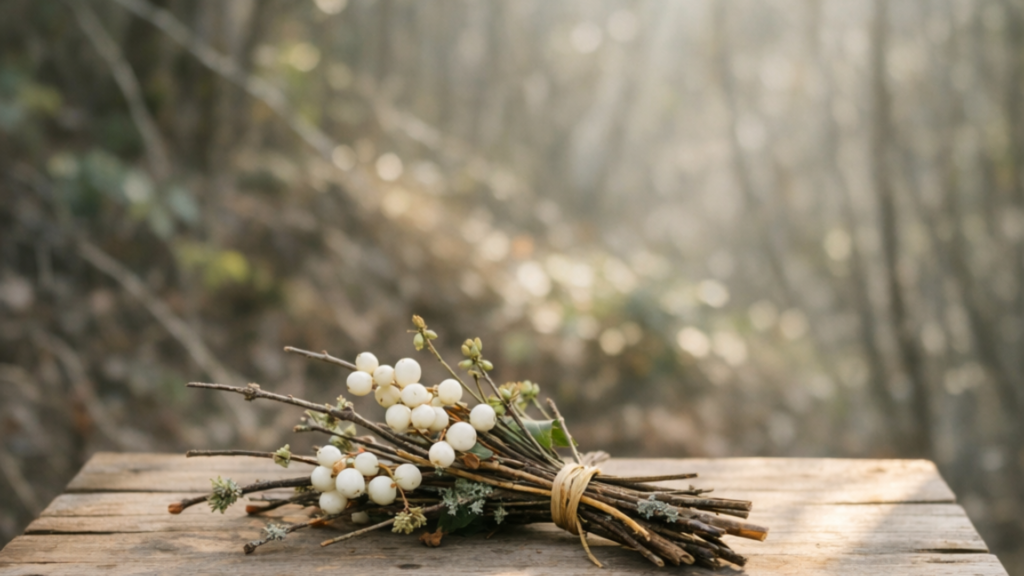
Autumn — Color and Woodland Ephemera. Snowberry punctuation, lichen on weathered branch, vine maple in flame. Autumn reopens the season with tonal richness and textural depth that no imported material can replicate.
July and August remain intentionally quiet — a pause for woodland recovery, stewardship observation, and preparation for the return of seasonal harvests. For projects near a seasonal edge, Diane will discuss honestly what the woodland is likely to offer for those specific dates.
The Species Atlas documents individual species behavior, conditioning, and design integration in detail.
The Process
Every project follows the same arc — the designer shares the story they are building; Diane responds with what the woodland can honestly offer, and together they shape a harvest plan that fits the design.
Step 1 – Share Your Project
Send a note through the Contact form with your dates, location, general scale, and the feeling you are working toward. A full recipe is not needed — just enough to understand the architecture, palette, and mood. Projects that begin with seasonal openness tend to be the strongest fit.
Useful details to include: design dates and preferred pickup window, palette direction and mood references, project scale and key mechanics — tall vessels, low compotes, foam-free installs, hanging work — and any materials you are particularly drawn to or would prefer to avoid.
Step 2 – Seasonal Possibilities
Diane will respond with what is likely in season for your dates — specific woody stems, evergreens, and woodland ephemera suited to your project’s form and feeling. Think of this as a seasonal sketch rather than a rigid menu.
Step 3 – Confirm and Plan the Harvest
Once the direction and budget align, Diane will confirm estimated quantities, pricing, and pickup details. From there, she plans the harvest so stems arrive at the right moment for your design window. For weddings and larger events, four to eight weeks of lead time gives the woodland the most room to work with your dates.
Step 4 – Pick Up the Woodland
Conditioned, ready-to-design botanical materials — stems with character, seasonal honesty, and a clear sense of where they came from. Diane will flag any surprises the weather has offered and suggest swaps that keep the design story intact.
All pickups are by appointment only in Arlington, WA, 3 minutes off I-5 at Exit 212. This keeps stems as fresh and unhandled as possible.
Boundaries That Protect the Work
Clear boundaries keep the work honest — for the designer, for Diane, and for the woodland. These are not limitations. Rather, they are the conditions that make genuine seasonal collaboration possible.
Seasonal honesty. Diane will not promise stems the woodland is not offering, even if a wholesaler somewhere has them on a list. What the woodland gives is what the atelier offers.
Small-batch harvesting. Every harvest is cut at a scale that protects plant health and design quality. Larger orders may need more lead time or a different approach — reach out early to discuss what is realistic.
Weather-aware flexibility. Frost, heat, and storm cycles can shift timing. If something changes, Diane will communicate clearly and offer thoughtful alternatives that serve the design intention.
No rush harvest. The woodland is not stripped for last-minute emergencies. If a project is close on time, Diane will be honest about what is possible rather than compromise material quality or plant health.
Design respect. Diane understands mechanics, line, and composition. Any suggested substitutions are made to support the design language, not work against it.
A mutual commitment
Woody Shoots brings stems with character — native-led, thoughtfully harvested, and rooted in this specific piece of Pacific Northwest land — along with clear, candid communication about what is possible each season. The Washington Native Plant Society documents the native species ecology that informs this practice.
In return, the designers who work best with Woody Shoots bring their designer’s eye, genuine curiosity, and a willingness to collaborate with the season as it is — not as a fixed list.
If that sounds like the way you like to work, the woodland is ready for the conversation.
Share your project with Diane →